
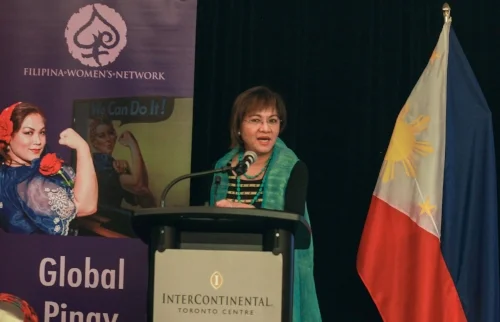
Undersecretary Nora Kakilala Terrado: Updates on the State of the Philippine Economy
Philippine Department of Trade and Industry Undersecretary Nora Kakilala Terrado (Global FWN100™ 2014, Global FWN100™ 2016) delivered her keynote on Updates on the State of the Philippine Economy at the 14th Filipina Leadership Global Summit held in Toronto, Canada on October 27, 2017.
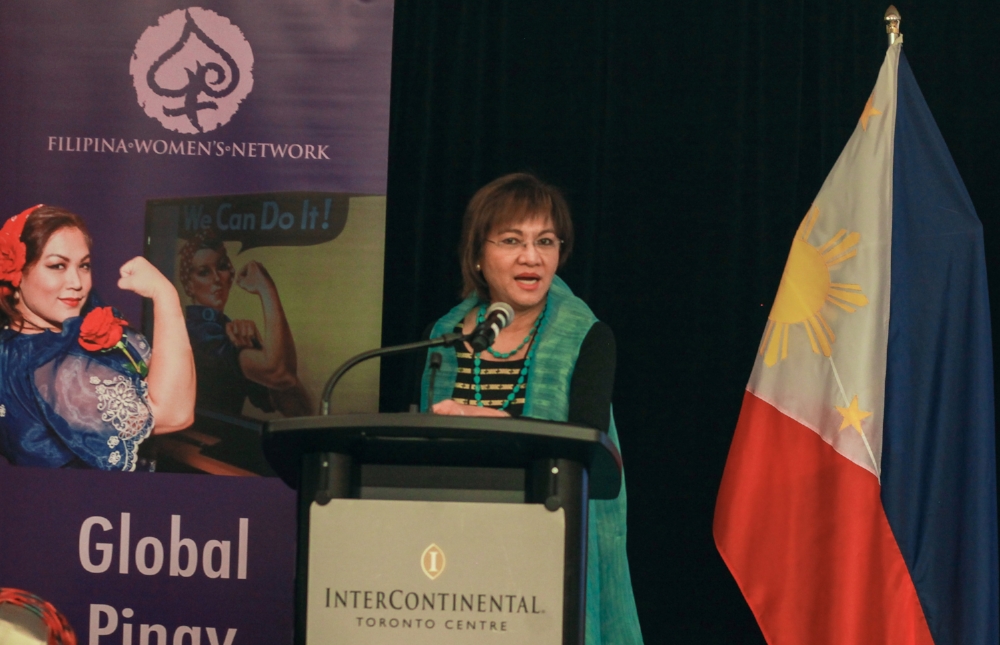
Philippine Department of Trade and Industry Undersecretary Nora Kakilala Terrado (Global FWN100™ 2014, Global FWN100™ 2016) delivered her keynote on Updates on the State of the Philippine Economy at the 14th Filipina Leadership Global Summit held in Toronto, Canada on October 27, 2017.
Below is the full text of her keynote speech.
A pleasant morning to everyone.
It is my pleasure to meet you all and present the many positive developments in The Philippines. I am here to encourage those of you who are on the lookout for the best investment opportunities available and assure those who have already invested that our ountry’s growth is permanent and sustainable.
Kindly allow me to reaffirm today that The Philippines is open and ready for more of your business.
The Philippines: The Bright Spot in Asia
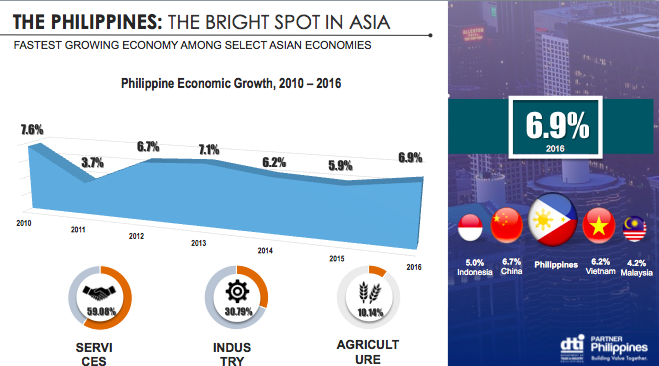
In this regard, I wish to emphasize that The Philippines continues to be a prime investment destination not only in the ASEAN region but in the world. This strong investment position is due in large part to the Philippine economy’s continuing robust performance after proving its innate resilience in the face of global uncertainties.
From 2011 to 2016, The Philippines’ gross domestic product (GDP) recorded an average growth rate of 6.1 percent.
In 2016, The Philippines was the fastest-growing economy among selected Asian economies, posting a robust 6.9 percent growth in GDP, surpassing China (6.7%), Vietnam (6.2%) and Indonesia (5.0%) and Malaysia (4.2%).
This is a strong affirmation that our economy is indeed steadily traversing a high growth path, ascending on the solid efforts by both public and private sectors.
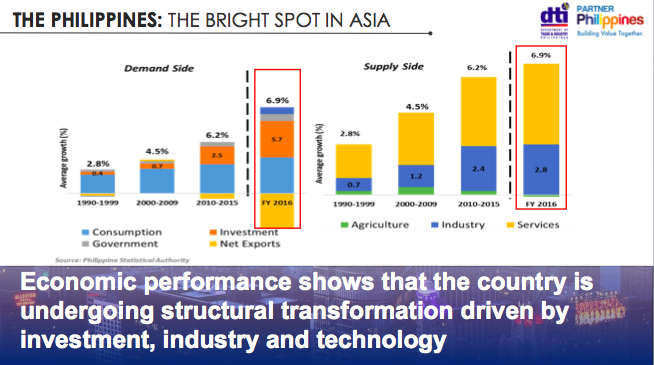
The economy is also undergoing structural transformation. This means that growth is increasingly being driven by investments vis-à-vis consumption, and led by the industry sector relative to the service sector. In other words, sources of economic growth have broadened. Such qualitative change of the economy is crucial to sustaining growth and generating more stable quality jobs.
Total factor productivity (TFP) growth of the economy in recent years has been the fastest in ASEAN, at 2.3 percent. Which also means that capital efficiency (incremental capital output ratio or ICOR) has been improving)
These suggest that economic growth is sustainable, thereby capable of generating more stable and gainful jobs.
The Philippines is one of the world's fastest-growing countries. Real GDP should increase by 6.3% in 2017 after gains of 6.9% in 2016. Robust growth in private final consumption and an increase in public spending on infrastructure (predicted to be 5.8%) are the main drivers. Improvements in investor confidence and rising FDI provide additional support.
The real value of private final consumption rose by 6.5% in 2016 and an increase of 6.4% is expected in 2017. Steady growth in employment and public sector spending provide support

Table 1 details the sources of growth or where growth is coming from.
On the supply or production side, growth in the services sector improved to 7.4 percent, and industry grew 8.4 percent in 2016. However, agricultural growth was a letdown as it reverted to negative territory in the fourth quarter, and for the whole of 2016, reeling from the effects of typhoons “Karen” and “Lawin”. If not for these typhoons, real GDP growth could have hit closer to 7 percent in 2016, as we had hoped.
Domestic demand continued to fuel growth throughout 2016. A robust expansion in investments, growing 25.2 percent in 2016. Public investment in infrastructure remained strong with public construction growing by 28 percent. Private consumption grew 7.0 percent in 2016. All this is attributed to high consumer confidence, modest inflation and interest rates, and improving labor market conditions.
External demand expanded by 10.7 percent in 2016, with merchandise exports rising by 9.2 percent and exports of services maintaining its double-digit growth of 16.2 percent. Growth in imports likewise accelerated by 18.5 percent for the year, reflecting higher purchases of capital and durable goods, which indicate business and consumer confidence, and sustainability of growth.

Growth of the country’s real gross domestic product (GDP) accelerated to 6.5 percent in the second quarter (Q2) of 2017. This is faster than the 6.4 percent growth in the preceding quarter, albeit slower than the 7.1 percent growth in the same period in 2016. Growth in the second quarter of 2017 was in line with the expectations of the market given the 6.5 percent consensus median estimate. This puts the country to be well on track in meeting the lower-end of the full year target range of 6.5 to 7.5 percent GDP growth for 2017.
Gross national income (GNI) growth likewise improved to 6.8 percent in Q2 2017 from 6.2 percent in the previous quarter, albeit still slower than the 7.0 percent in Q2 2016. The acceleration in GNI is supported by the marked increase in net primary income (mainly compensation income) at 8.6 percent. This is faster compared to the 5.4 percent in Q1 2016 and the 6.1 percent recorded in the same period of 2016.
On the supply side, the service sector is still the main driver of growth despite posting a deceleration for the period (+6.1% from +6.7% in Q1 2017 and +8.2% in Q2 2016). Meanwhile, the industry sector recorded marked improvements (+7.3% from +6.3% in Q1 2017 and +7.6% in Q1 2016), supported by the faster expansion in the manufacturing sector, and partly due to the rebound in the mining and quarrying sector. The agriculture sector, which accounts for about 26 percent of total employment, continues to show sustained growth and posted gains (+6.3% from +4.9% in Q1 2017 and -2.0% in Q2 2016) in the second quarter following the increase in production in the cereals and poultry sector.
On the expenditure side, domestic demand slowly gained traction in the second quarter of the year (+6.7% in Q2 2017 from +6.5% in Q1 2017 and +13.0% in Q2 2016), mainly sustained by private consumption and a recovery in government spending. Consumer spending was up slightly to 5.9 percent in Q2 2017 (from +5.8% in Q1 2017 and +7.5% in Q2 2016), supported by record high consumer confidence, modest inflation and interest rates, and improving labor market conditions. Government consumption likewise improved to 7.1 percent, from a measly 0.1 percent growth in Q1 2017 (still lower than the 13.5% recorded a year ago). Meanwhile, investment (+8.7% in Q2 2017 from +10.6% in Q1 2017 and +30.3% in Q2 2016) was tempered by the tepid expansion in durable equipment as well as in private construction.
External demand remained strong, with exports of goods rising to 23.0 percent in Q2 2017 (from 22.8% in Q1 2017 and 8.0% a year ago), while services exports growth decelerated to 9.9 percent (from 12.4% in Q1 2017 and 19.3% a year ago). Likewise, imports growth remained brisk at 20.6 percent, slightly lower than the 22.2 percent relative to Q1 2017 and the 26.3 percent recorded in the same quarter a year ago. Services imports growth bounced to 10.7 percent in Q2 2017, from 4.7 percent in Q1 2017 (though still slower than the 22.0% growth recorded a year ago).
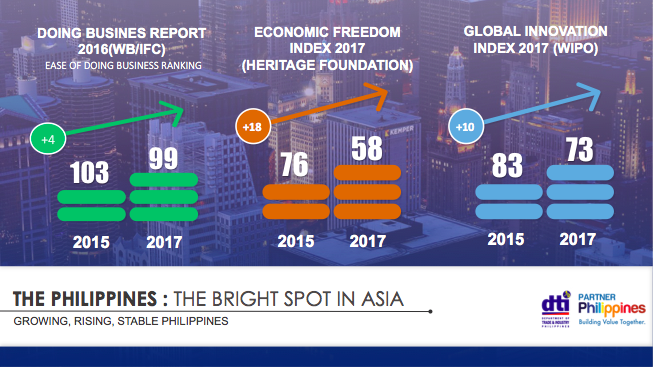
The country’s global competitiveness ranking has continued its marked improvement.
The Philippines climbed four notches in the Doing Business Report from 103rd in 2015 to 99th out of 190 economies in 2016. This was aided by the increased transparency in building regulations. Paying taxes has also been made easier by introducing an online system for filing and paying health contributions, and by allowing for online corporate income tax and VAT returns to be completed offline.
The country has also made it to the top-third of the rankings in the Heritage Foundation’s Economic Freedom Index 2017, up twelve notches to rank 58th out of 180 countries, maintaining its status as a “moderately free” country for four years.
The Philippines also moved up 9 rungs in the Global Innovation Index from 83rd out of 141 economies in 2015 to 74th out of 128 economies in 2016 and up one more to 73rd out of 127 in 2017, as measured by the World Intellectual Property Organization.
The country’s credit rating has continued to improve over the years. As of 2017, the top three rating agencies — Fitch, Moody’s, and Standard & Poor’s — affirmed the country’s “investment grade” rating. The Tokyo-based Japan Credit Rating Agency Ltd. has also affirmed its BBB+ credit rating for the Philippines.

The increasing global competitiveness of the Philippine economy is reflected in the sustained growth in net foreign direct investment (FDI) inflows (FDI) since 2012. The upward trend indicates the growing interest of investors who wish to take advantage of the opportunities presented by the country’s robust economy and stable business environment.
In 2016, FDI reached US$7.9 billion, up by 41 percent over inflows in 2015. Top sectors that gained inflows in 2016 were financial and insurance activities, arts, entertainment and recreation, manufacturing, real estate activities, and construction.
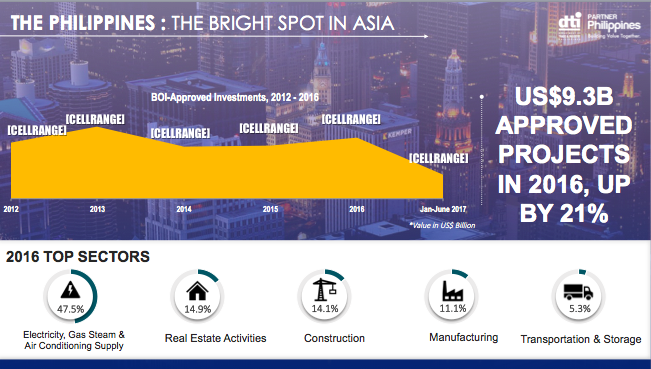
With the sustained improvements in the overall business environment, the Board of Investments (BOI) approved US$9.31 billion worth of projects in 2016, representing a 21 percent increase in investment commitments in 2015.
The top sectors that gained capital commitments in 2016 include Electricity, Gas, Steam & Air Conditioning Supply (47.5%), Real Estate Activities (14.9%), Construction (14.1%), Manufacturing (11.1%), and Transportation and Storage (5.3%). The top sources of foreign capital were Australia (34.1%), Singapore (15.3%), The Netherlands (14.6%), Canada (7.6%), and South Korea (7.2%).
This 2017, some US$3.7 billion worth of projects were approved in the period January-June. The capital commitments were made in Real Estate Activities (42.5%), Construction/PPP Projects (31.7%), Electricity, Gas, Steam & Air Conditioning Supply (13.6%), and Manufacturing (10.1%). The top sources of foreign capital were Singapore (52.2%), USA (11.7%), The Netherlands (10.9%), Denmark (7.9%), and India (5.1%).
Philippine Development Plan (2017-2022): AmBisyon Natin 2040
Under the leadership of President Rodrigo R. Duterte, our country is poised to continue and sustain its remarkable growth and spread prosperity across all sectors with a 10-point Socio-economic Development Agenda:
- Continue and maintain current macroeconomic policies, including fiscal, monetary, and trade policies.
- Institute progressive tax reform and more effective tax collection, indexing taxes to inflation.
- Increase competitiveness and the ease of doing business. This effort will draw upon successful models used to attract business to local cities (e.g., Davao) and pursue the relaxation of the Constitutional restrictions on foreign ownership, except on land ownership, to attract foreign direct investment.
- Accelerate annual infrastructure spending to account for 5 percent of GDP, with Public-Private Partnerships (PPP) playing a key role.
- Promote rural and value chain development toward increasing agricultural and rural enterprise productivity and rural tourism.
- Ensure security of land tenure to encourage investments and address bottlenecks in land management and titling agencies.
- Invest in human capital development, including health and education systems, and match skills and training to meet the demand of businesses and the private sector.
- Promote science, technology, and the creative arts to enhance innovation and creative capacity towards self-sustaining, inclusive development.
- Improve social protection programs, including the government’s Conditional Cash Transfer program, to protect the poor against instability and economic shocks.
- Strengthen implementation of the Responsible Parenthood and Reproductive Health Law to enable especially poor couples to make informed choices on financial and family planning.
In line with the 10-point Socio-economic Agenda, the Philippines’ Department of Trade and Industry with its Board of Investments formulates The Philippines’ Investment Priorities Plan (IPP) that identifies sectors where incentives are offered by the government. The IPP, which has a validity of three years subject to annual review, ensures continuity, consistency, and predictability.
Factors taken into consideration in identifying these priority sectors include job generation in pursuit of inclusive growth as well as opportunities for technology transfer and knowledge/technical skills enrichment. Spatial or geographical requirements as well as industry clustering strategies in attracting investments are also considered.
Under the IPP, there are four priority investment areas: Preferred Activities, Export Activities, Activities with Special Laws, and the Autonomous Region of Muslim Mindanao (ARMM) List.
Under this list, the Top Ten Preferred Activities are:
- Manufacturing
- Agriculture, Fishery, and Forestry
- Strategic Services
- Healthcare Services
- Mass Housing
- Infrastructure and Logistics
- Environment Projects
- Energy
- Innovation Drivers
- Inclusive Business Models
Export Activities cover the manufacture of export products, services exports, and activities in support of exporters.
Activities with Special Laws include areas or activities where inclusion of the IPP and/ or grant of incentives is mandated by law, such as Industrial Tree Plantation (PD 705), Mining (RA 7942), Publication or Printing of Books/Textbooks (RA 8047), Tourism (RA 9593), Refining, Storage, Marketing and Distribution of Petroleum Products (RA 8479), Rehabilitation, Self-Development and Self-Reliance of Persons with Disability (RA 7277), Renewable Energy (RA 9513).
ARMM List include priority investment areas identified by the Regional Board of Investments of the Autonomous Region in Muslim Mindanao. This includes Logistics, BIMP-EAGA (Brunei Darussalam-Indonesia-Malaysia-Philippines East ASEAN Growth Area) related investment enterprises, Tourism, Health and Education Services and Facilities, and Energy.
Opportunities for Investors and Business
Infrastructure Development
In The Philippine Development Plan (PDP) 2017-2022, a key strategy is the development and implementation of infrastructure projects to further the ease of doing business and increase productivity and efficiency by facilitating the smooth flow of people, goods and services.
This offers an abundance of investment opportunities in the development of power and utilities; roads and bridges; water and sanitation; railways, airports and ports; information and communications technology; and security and defense.
Moreover, The Philippines has over 366 economic zones and offers a set of competitive fiscal and non-fiscal incentives to jump start qualified projects from infancy to maturity of business operations.
Fiscal incentives include Income Tax Holiday and Special Tax Rate on Gross Income while non-fiscal incentives include duty-free importation of capital equipment, spare parts and supplies as well as duty-free importation of raw materials and supplies used in export.
While the Income Tax Holiday does not provide exemption from real estate tax, machineries installed and operated in ecozones for manufacturing, processing, or other industrial purposes shall be exempt for the first three years of operation of such machineries. Production equipment not attached to real estate shall be exempt from real property taxes.
A total of 64 big-ticket projects ranging from major road networks, railway systems and bus rapid transit systems to airport and seaport modernization are either for implementation or in the pipeline as part of the Duterte administration’s envisioned “golden age of infrastructure.”
Besides its current projects, the Department of Public Works and Highways (DPWH) is also set to either oversee or implement 10 infra projects in Metro Manila and Mindanao. Among these are: These are the: Bonifacio Global City-Ortigas Center Link Road Project; UP-Miriam-Ateneo Viaduct along C-5/ Katipunan; Metro Manila Priority Bridges Seismic Improvement Project (Guadalupe Bridge and Lambingan Bridge; Widening/Improvement of Gen. Luis St.-Kaybiga-Polo-Novaliches; Cavite-Laguna Expressway; NLEX-SLEX Connector Road; Metro Manila Interchange Construction Project VI; Davao City By-Pass Construction Project (South Section (Road) and Center Section (Tunnel); Panguil Bay Bridge, and Phase 1 of the Metro Manila Flood Management Project.
The Philippines' Strategic Location
The Philippines — strategically located in Asia with a network of international sea lanes and air traffic routes traversing the country — is your ideal gateway to the ASEAN Market. Reachable within 2 to 4 hours by plane and within 24 hours by ship from Asia’s major key cities and travel centers, our country offers one of the fastest, if not the best, access to serve your business interests in the ASEAN market of more than 600 million people, roughly the same size as the European Union today.
The Philippines also provides access to ASEAN’s six free trade agreements with Japan, China, Korea, India, Australia and New Zealand.
Philippines in Demographic Sweet Spot
Apart from our robust economy, strategic location and competitive business environment, the other main attraction for investing in The Philippines is the Filipino people. We have a populatieon of about 100 million with a median age of 23 years. These young people — well educated, highly trainable, hardworking, loyal, and English speaking — comprise our country’s primary asset.
These traits are why there are 10 million Filipinos working outside The Philippines as doctors, nurses, architects, engineers, accountants, teachers, mechanics, seafarers, and all sorts of service staff.
These same traits are also why our Information Technology - Business Process Management (IT-BPM) industry has grown dramatically, from a mere 5,000 workers in 2000 to more than a million to date.
Human Capital Advantage
The competitive advantage afforded by our workforce is highlighted by a recent study conducted by the Japan External Trade Organization (JETRO) where The Philippines was consistently ranked first, ahead of India, Indonesia, Thailand and Vietnam in all categories, including:
- Having Less Linguistic / Communication Problems;
Ease of hiring local staff;
High Quality of Employees, from General Workers to Specialists, Engineers, and Managers;
High Employee Retention Rates
Today, the Philippines is the only Asian country in the top ten of the Global Gender Gap Report of the World Economic Forum. It ranked 7th in the world in 2016 and has consistently been in the top 10 since the first report in 2006.
The report’s Global Gender Gap Index measures the relative disparities between women and men across four key areas: Health, Education, Economy and Politics.
The Philippines has fared well especially in Heatlh and Education, we have been able to ensure that females enter, remain and finish school.
Women’s participation in decision-making and leadership positions has prospered too. More women are getting elected to the Senate and the House of Representatives as well as in Provincial, City and Municipal governments.
As for women’s economic empower, this is supported by appropriate laws and policies which are operationalized in development plans. These include:
RA 7882 “Act Providing Assistance to Women Engaged in Micro and Cottage Business Enterprise”
RA 9501 “Magna Carta for Micro, Small and Medium Enterprises”
RA 10644 “Go Negosyo or Go into Business Act”
Women are key players in the MSME sector. Our data in the Department of Trade and Industry show that 53% of enterprises that registered trade names were own by women, while a study by the Asian Institute of Management (AIM) noted that 63% of managers/owners of businesses they surveyed were women.
Philippines-Canada Trade Relations

At this point, I would like to acknowledge the considerable support that the Canadian International Development Agency has been giving The Philippines in this regard, particularly for the development of cooperatives and micro, small and medium enterprises, the protection of the environment, and the empowerment of women and youth.
We realize, that we will only continue to reap continued economic success with the help of partners. Thus, we are looking to deepen our economic partnership with Canada. Quite frankly, there is a lot of room for improvement in the area of trade and investments.
In 2016, The Philippines was Canada’s 21st trading partner (out of 226), 16th export market (out of 213), and 26th import supplier (out of 207).
Total trade grew continuously over the 5-year period 2011 to 2015 by an average of 6.5 percent with the balance of trade in favor of Canada. However, this slowed down by 8 percent from US$1,027 million in 2015 to to US$945 million in 2016.
Our top export products include: ignition wiring sets (and other wiring sets used in vehicles, aircrafts or ships); electronic conductors (with voltage not exceeding 80v and not fitted with connectors); desiccated coconuts, fresh or dried; syringes, with or without needles; and digital monolithic integrated circuits.
On the other hand, our top import products from Canada are: wood (sawn or chipped, sliced or peeled, of a thickness exceeding 6mm); builders’ joinery and carpentry of wood; wheat and meslin; potassium chloride; and meat of swine, frozen.
Golden Opportunities for Partnerships
In terms of trade, we look to narrowing the gap in our balance of trade by increasing our exports of processed food products (such as fruits, vegetables, marine and ethnic foods), personal care products, furniture, homestyle products, and wearables.
As for investments, the recent pivot of Canada toward Southeast Asia and the ongoing talks to expand economic ties with ASEAN is quite encouraging. We hope that with this Canada will ramp up its investments in The Philippines and make us your primary gateway to ASEAN.
We are particularly interested in securing partnerships in Information Technology – Business Process Outsourcing (IT-BPO) particularly in game development, animation, and Health Information Management System (HIMS).
We also seek more investments and technology transfer in our Manufacturing Sector that has been experiencing a resurgence over the last three years, especially in the areas where you have an acknowledged lead such as aerospace, electronics, food processing, and consumer products.
And, as presented earlier, we are equally keen on forging partnerships for the continuing development of our Infrastructure, which is key to our sustained growth over the long term.
We have high hopes that today will be the start of a new chapter of a deepening economic partnership between our two countries.
Thank you very much and good day.

Rosario Cajucom-Bradbury: Global FWN100™ Acceptance Speech on Behalf of the Most Influential Filipina Women in the World, 2016
Rosario Cajucom-Bradbury (Global FWN100™ '16) Adviser to The Wallace Business Forum (WBF), Former Managing Director & CEO, SGS Philippines & SGS Gulf Ltd. ROHQ Former Chairwoman of Philippine Swiss Business Council delivers the Global FWN100™ Acceptance Speech on behalf of 2016's Most Influential Filipina Women in the World.

Rosario Cajucom-Bradbury (Global FWN100™ '16) Adviser to The Wallace Business Forum (WBF), Former Managing Director & CEO, SGS Philippines & SGS Gulf Ltd. ROHQ Former Chairwoman of Philippine Swiss Business Council delivers the Global FWN100™ Acceptance Speech on behalf of 2016's Most Influential Filipina Women in the World.
Greetings Honored Guests and Dignitaries,
I am pleased to welcome you to the Global FWN100™ Gala Awards Dinner Ceremony at the 13th Filipina Leadership Global Summit.
Tonight we celebrate 100 women who have reached the heights of excellence in their respective fields. Some in corporate business, some in government, some in non-profit, all of whom have demonstrated impact, innovation, involvement, femtorship, professionalism, and sustainability in their respective areas of contribution. In making the awardee selection, the selection committee reviewed elements of leadership, challenge, and ownership across each of the candidates’ qualifications to make its selection. Those nominees who demonstrated the highest level of attainment across all of these elements are here with us tonight.
In attendance, we have those 100 of 2016's Most Influential Filipina Women around the globe. We have 10 countries represented including 5 awardees from Europe, 11 awardees from North America, 4 awardees from the Middle East, and 49 awardees from Asia, including 46 awardees from right here in the Philippines.
We also have dignitaries representing countries who have made a special commitment to be with us tonight. We are ever so grateful to these busy individuals for taking the time out of their hectic schedules to visibly demonstrate the importance of Filipina Women taking on leadership roles around the world and making a meaningful impact in their respective communities and greater societies.
I'd also like to take a moment to thank this year’s event sponsors. Our Ninang sponsors, Ramar Foods International and Wells Fargo, our Kababayan sponsors AT&T and Chevron, our Kasama sponsors, Seven Seven Corporate Group, The Filipino Channel, and the Golden State Warriors. And our many Kaibigan sponsors who have all helped to make this years Global Summit an outstanding success.
Of course, I want to welcome and thank the hundreds of friends, relatives, children, and spouses who are here (and not here) with us tonight to celebrate their mother’s, their daughter’s, their wives’, their sister’s, their friend’s, their colleague’s incredible achievement, not just this past year, but the years of dedication, painstaking work and effort to establish their careers and achieve the pinnacle of success in their respective endeavors. It is these family and friends who have accepted the sacrifice of time and distance while their family member or friend has pursued their dream. On behalf of the 100 awardees tonight, we thank you most of all.
Lastly, I'd like to recognize the young femtees in the audience. FWN is extremely dedicated to the development of young Filipinas, helping to support and guide you on your path to leadership roles and career and life success. We hope your time here tonight, in the presence of 100 women who have already accomplished what you may dream to someday achieve, in some small way, can help to inspire you on your desired path.
FWN began back in 2002 in San Francisco, California with the idea that one small group could make a real change in society, and particularly in the lives of Filipina women. 13 years later, Marily Mondejar, the founder and CEO of FWN and the countless others who have supported FWN and participated in its growth and development along the way, can certainly look back with great pride on what has already been accomplished to date, and can look forward with great anticipation to the road ahead. Next year's summit and gala celebration will take place in Toronto, Canada, 2018 in London, England, my personal favorite, 2019 in Hawaii, and the Pinay Power 2020 reunion in Washington DC, right in time for the next U.S. presidential election.
A brief personal aside: I first became aware of FWN last year, when I attended the 2015 Gala event in San Francisco and met an amazing group of female role models. Shortly thereafter, FWN provided me with an opportunity to fulfill a long sought dream. In my college days, I was a theater arts major. When I learned FWN was staging the Vagina Monologues in San Francisco in honor of the comfort women of WWII, I jumped at the opportunity. Fortunately, I still retained my theater arts skills, kept active over the past 10 years in the office of the CEO, where much of what we do as chief executives, is stage performance. Through the Vagina Monologues production, I was introduced to Marily and again, so many incredible women, each with a personal story to tell. My path of engagement with FWN was set.
But tonight is not about me, or even about Marily and the rest of the Filipina Summit steering committee, headed this year by Myrna Yao. Tonight is about this year’s 100 awardees. Tonight is about celebrating and savoring the fruits of your countless years of effort culminating in the collective celebration this evening.
In closing, I'd like to close as I do with all my presentations, with words of wisdom, from my wise-beyond-his-years, newly teenage son. His latest writing, a poem, is called Time is no Thief. In this poem, he writes that it is not “Time which wastes time, but only us.” Let us not waste this moment tonight to enjoy the company of each other and to take the moment to positively reflect upon the incredible accomplishments achieved by those in this room tonight. Please do not waste this chance.
Thank you and enjoy... congratulations to 2016’s 100 Most Influential Filipina Women in the World!

Rosario Cajucom-Bradbury (Global FWN100™ '16) received the Global FWN100™ award in the Builder category in recognition of of her exceptional business impact, deep passion, collaborative initiatives in her capacities as Adviser to The Wallace Business Forum (WBF), the Former Managing Director & CEO, SGS Philippines & SGS Gulf Ltd. ROHQ and Former Chairwoman of Philippine Swiss Business Council.

Lorna Patajo-Kapunan: The Secrets of Successful Women
Lorna Patajo-Kapunan (Global FWN100™ '16) delivered her leadership keynote at the Global FWN100™ 2016 Gala Dinner and Awards Ceremony during the #FWNSummit2016 in Cebu, Philippines on Tuesday, August 23, 2016. Lorna was awarded the Builder award in recognition of her deep passion for causes through collaborative initiatives or alliances with corporations or nonprofit organizations on behalf of her firm, Kapunan, Garcia & Castillo Law Offices.
"If there's one hallmark for successful women, it's that they're exceptionally hard workers and some are slave to their jobs. But hard work has many faces and like success itself, means different things to different people. I believe that the critical factor is not the number of hours women work as much as the intensity of focus. Working hard has a negative connotation. What is important is loving what you do." - Lorna Patajo-Kapunan (Global FWN100™ '16)

Lorna Patajo-Kapunan (Global FWN100™ '16), Senior Partner, Kapunan Garcia & Castillo Law Offices delivered her leadership keynote "The Secrets of Successful Women" during the Global FWN100™ 2016 Dinner and Awards Ceremony on August 23, 2016 at Shangri-La Mactan in Cebu, Philippines
Lorna Patajo-Kapunan (Global FWN100™ '16) delivered her leadership keynote at the Global FWN100™ 2016 Gala Dinner and Awards Ceremony during the #FWNSummit2016 in Cebu, Philippines on Tuesday, August 23, 2016. Below is the full text of her keynote speech.
It’s a fact. We’ve entered the era of the successful woman the high flyers & high earners. Yet the remarkable progress of these successful women has been surprisingly low profile. Why? In large part because until recently they didn’t exist. “It is only in the last two decades that women have had [substantial] personal earnings from their own activities,” their own talent competence and resources. The woman CFO/COO—is no longer Child of Owner (or wife).
But successful women are still a minority. Fewer than 20 percent of six-figure earners are female. Most women remain sorely underpaid. In virtually every field, women make 50 to 80 percent of what men make.
Do successful women have to work absurdly long hours, forfeit their femininity, forgo their happiness, give up all semblance of a personal life? Do their marriages hold up? Do their children suffer? Do they bear lasting scars from breaking glass ceilings or battling gender bias? Is it possible for women to become high earners?
Some of us believe the myth that managing money is clearly a man's job. This was what was pounded on us when we were young. The man is the breadwinner. The women takes care of house and children. Ang babae ay pang Kusina or pang Kama lang. Some of you don’t even cook—or have sex.
For far too many women, their financial limits have become a fact of life. The thought of making more is like climbing Mount Everest, a colossal, if not impossible, task. They may have the desire, but they lack the hope or belief in themselves to meet the challenge.
Numerous psychologists have told me that the amount people earn indicates how they feel about themselves, like a mirror reflecting back their level of self-worth. But in my dealings with successful women, I wasn't clear which came first. Did people make more because they felt good about themselves, or did they feel good about themselves because they were paid more?
If there's one hallmark for successful women, it's that they're exceptionally hard workers and some are slave to their jobs. But hard work has many faces and like success itself, means different things to different people. I believe that the critical factor is not the number of hours women work as much as the intensity of focus. Working hard has a negative connotation. What is important is loving what you do. In some cases, women do not know where their work stopped and their personal life began.
These are superwomen probably most of you here, who are on steroids who have no clue on how many hours they worked; they just know how few hours they slept. These women will break down. They may have once loved their job but their passion had turned to obsession, their work had become an addiction, their long hours felt more like hard labor, and their generous salaries were but golden shackles.
But money isn't the only reason successful women have lopsided lives. Overwork has become an occupational hazard for ambitious women trying to make it in a man's world. It is often said that "women have to make disproportionate sacrifice to compete equally in the work world." Women have to work twice as hard as the men just to keep up. It's an easy, perhaps inevitable, trap to fall into, but the successful women get out of this trap before it's too late.

Working Hard Doesn't Mean Working All the Time
"Overwork is a self-inflicted punishment. I don't do that anymore." This theme of working less and making more is especially true among the entrepreneurs. Not so much in their early years of doing business, but eventually many of them came to the same conclusion.
It was the intensity of focus on their work, not the number of hours they spent doing it that factored so heavily into these women's financial success.
WHAT DRIVES SUCCESSFUL WOMEN
Money is not the motivator- it is what money represents. Successful women are driven more by what they hope to achieve than what they aspire to earn. Each woman has her own definition of what the money symbolizes and what achievement means.
Focus on Fulfilling Your Values Rather Than Financial Gain.
Successful women have a vision for their lives based on cherished values like recognition, security, challenge, or independence. This intangible goals, more than hard cash, provide the fuel for their financial success. Money became the by-product of their value-based ambition and, simultaneously, gave them more opportunities to live out their authentic values.
If making money is the goal, you’ll never make enough to be happy. You’ll always want more. A lot of people fall into this trap and never find happiness because they’re always chasing money.”
LOVE RULES!
What’s important, is to follow your heart.
Successful women love what they do for a living. This passion for work plays a much more significant role in women’s success than any impressive credential or high-flying career.
Loving what You Do Is Much More Important Than What You Do.
“If you’re not passionate, you shouldn’t be doing it.” “I think passion is more important than what field you’re in, more important than hard work.”
I believe, no matter how impossible it seems, once you decide to do what you love and be excellent at it, the money will come.
DO WHAT YOU FEAR
“You have to believe in yourself, that you can do anything you set your mind to.” That catchphrase---I can do anything---emerged as a recurring mantra for successful women.
Belief in yourself doesn’t mean the absence of self-doubt.
Every woman admits to grappling with feelings of inadequacy, incompetence, and fear. Fear of failure, fear of rejections, fear of criticism lay like fault line just below the surface. But successful women look and act confident even when they don’t feel it. “It’s like being a duck. Calm and unruffled on the surface, but paddling like hell underneath.”
“There are times I’ve sat in our board of directors meeting looking as if I’m reading a complicated report and I don’t know what the hell I’m looking at . But I put on a good show. I’m somehow able to pull it off.”
A woman CEO told me-- “I know, I worry people will see I’m not that smart. A therapist told me it’s called the Imposter Syndrome. “I’m so afraid people will discover how dumb I am. I wrestle with this all the time.”
Some reference to the Imposter Syndrome ran through so many of these women’s stories. Beneath their confident exteriors lurked layers of insecurity. Yet despite their qualms, these women, managed to become incredibly successful, professionally and financially. How did they do it?
Feel the Fear, Have the Doubts. Go for It Anyway.
Feeling like a fish out of water was a common theme among aspiring women I have met who made dramatic career changes into more lucrative (often male-dominated) fields. But the biggest challenge for nearly everyone was simply trying to stay afloat in a sea of endless obligation.
THE BALANCE BEAM
The whole notion of trying to achieve success on the job and enjoy a life outside of it is an ongoing struggle for practically every working woman.
It’s no surprise that balancing work and personal life is the most mentioned, most taxing quandary successful women encounter, particularly as they try to merge their desire for marriage and family with their aspirations for financial success. It is something men rarely have to deal with. “I’ve yet to hear a man ask for advice on how to combine marriage and a career,” women’s advocate Gloria Steinem once observed. But we hear it incessantly from women.
The struggle for balance is even more apparent in the life of the single mom.
Few people know that I am a single Mom. I lost my husband to Colon Cancer in 2001, I thought this was the end of the world—until in 2003, I lost the youngest of my sons (he was 8 years old then). That really was the end of the world for me, and I cursed my God “nag quota na ako Lord why me.” But I had to bounce back-- had 4 sons to take care of, my own law firm, a reputation of being a fighter. So I fought hard to keep body & soul together. The rest is History--- and God has been good to me!
“For a single working mom it’s always terrible balancing act. You’re never at work enough and never with the kids enough. You’ve got to make hard choices about your time. Sometimes you have to skip being home because you have to be at a business event. And then you’ll feel terrible that you’re not with your kids. It’s constant choices, and you never know if you’re making the right ones.”
Even with a husband at your side, mothering while working is still a herculean task.
The work/family dilemma is an intricate web of complex issues—issues of identity, autonomy, and a maternal instinct that exerts a fiercer pull than the force of gravity.
Successful women finally settled on a workable equilibrium. That seems to be what happens. Over time majority of high-earning women established their own brand of precarious balance. They each found, usually through trial and error, viable solutions for preserving their mental health while managing their multiple roles. Those solutions came from taking a hard look at their personal priorities, what they cherished most in life, and then discerning between what they thought they should do and how they really wanted to live their lives.
Think in Terms of Trade-offs, Not Sacrifices, to Find a Workable Equilibrium.
This battle for balance, to get overinvested in work but still do what it takes to advance, is ongoing for virtually every successful high earner.
NO ONE PROMISED US A ROSE GARDEN
There’s another battle that may be even more painful than juggling too many hats: contending with gender bias and sexual harassment. Not all successful women have to confront these problems. For those who do, however, it can be the most frustrating and distressing challenge of all.
Discrimination has always been a workplace threat from aspiring women, and these days, the higher a women climbs, the more acute this problem seems to become.
Corporate women complain of being excluded from social occasions, passed over for promotions, or ignored for tough assignments. Entrepreneurs resent not receiving the same referrals, networking opportunities, or start-up capital as their male colleages.
“I wish we were all treated equally, but it just isn’t the case,” an investment banker, told me. “The guys will get asked by the people that run the firm to go golfing, but they won’t ask me because I’m a woman. So my peers are hanging out with the decision makers on weekends and I am not invited.”
The solution—recognition, not resignation--- is how most successful women deal with gender bias and other injustices.
The point is to accept the fact of it, get angry enough to do something about it, but not blame or become a victim.
Many successful women also find strength in a sense of humor.
“My sense of humor is shock absorber”
These successful women figured out a key secret for dealing with prejudicial treatment without losing their temper, their footing, or their perspective:
Sometimes You Just Have To Shrug It Off and Have a Good Laugh.
THE HAPPINESS FACTOR
One thing is for sure: There’s plenty of stress in the success lanes. Coping with multiple roles, a challenging workload, and their minority status is no piece of cake for Successful Women. Yet despite the ubiquitous pressures, I found another frequentlyrepeated, and very surprising, theme. As a whole, successful women are a very happy bunch. Successful women learn from other successful women/mentors. None of us are successful on our own.
Successful women always count their blessings.
Appreciate Abundance.
We might want to rethink that old saying that money can’t buy happiness. [“But a] better predictor of happiness is a person’s satisfaction with his or her income. According to studies, the most highly compensated women receive less than 3 percent of what the best compensated men make. But instead of focusing on the disparity, or becoming disheartened by its implications, the women I spoke to recognized and appreciated that they were making more than most certainly more than most women, andin many cases, more than they had even dreamed they would. While everybody’s been fixated on doors that were closing, feeling cynical and resigned about what struggles might lay ahead, high earners were consistently finding, and opening windows of opportunity.
But financial success is not what successful women should be all about. We are blessed because we are meant to share our blessings with others.
I am known as a celebrity lawyer. A fighter with balls (I often want to retort—“why do you have a vagina?—but I do have cases not written about by media-- the 18 month old daughter raped by the father on drugs, the 13 year old student gang raped by policemen, the battered wife with 8 children refused support by the husband, the victims of domestic violence, oil spill case in Barangay Bangkal 87 families and a whole Barangay lost their homes, cases for World Wildlife Fund (WWF), Red Cross, Ballet Philippines, PETA (People for the Ethical Treatment of Animals), PAL Flight Attendants on their gender discrimination issues and many other pro bono cases. These are the cases that made me who I am today. My Mantra-- those who have less in life should have more in law. I come from a family of lawyers-- my father Justice Line M. Patajo was former Justice of the Supreme Court, my first cousin in law Justice Santiago Kapunan was also Justice of the Supreme Court, my husband was RTC Judge, my uncle was Executive Judge of Antipolo, my uncle-in-law was the prosecutor in Nalundasan case that sent Marcos to Jail—my 2 sons are now lawyers.
I stand by the belief that the law is a noble profession—regardless of the horror stories we hear on hoodlumsin robes. And so, let be leave you with this thought--- that we are successful because were are meant to be successful to help others help themselves.
Womenare great story tellers. Let me end with this story.
“UBUNTU” – A very nice story from Africa…
The motivation behind the Ubuntu Culture in Africa— An anthropologist proposed a game to the African tribal children. He placed a basket of sweets near a tree and made the children stand 100 meters away. Then he announced that whoever reaches the tree first would get all the sweets in the basket. When he said “ready steady go!”
Do you know what these Children did?
They all held each other’s hand, ran together towards the tree divided the sweets equally among themselves, ate the sweets and enjoyed it. When the anthropologist asked them why they did so—They answered UBUNTU which meant “How can one be happy when the others are sad? UBUNTU in their language means “I AM BECAUSE WE ARE”
A strong message for all generations—Let us always have this attitude and SPREAD HAPPINESS WHEREVER WE GO.
Mabuhay! I am—BECAUSE WE ARE!
RE-AFFIRMATION/REMINDERS:
Remember that you are still a woman.
Success does not mean you have to think, look, feel like a man.
While you strive, you still must be receptive.
While you are strong, you are allowed to cry.
While you wear power suits, you can still wear high heels and be flirty.
While you are in control, you can still be gracious.
Let us celebrate our “Womanity!”

Lorna Patajo-Kapunan (Global FWN100™ '16) pictured with FWN CEO & Founder Marily Mondejar and FWN President Susie Quesada.
About Lorna Patajo-Kapunan
Atty. Lorna Patajo-Kapunan is an advocate for Women’s and Children’s Rights as well as the Environment and Animal rights. She has the distinction of being the first to have obtained a Writ of Kalikasan from the Supreme Court for her West Tower/Barangay Bangkal Oil Spill Case.
Atty. Kapunan also vigorously fought for the preservation of the Arroceros Forest Park when the local government officials of Manila ordered the construction of the City Schools Division Office within the forest premises which prompted the killing of 187-fully grown trees. She also joined the clarion call to free the old and ailing elephant Mali from its pen in the Manila Zoo, among others.
On the economic front, Atty. Kapunan is the Legal Counsel of Kilusang Makabansang Ekonomiya (KME) which advocates economic nationalism and champions the fight against poverty and corruption in all branches of the Government.
Atty. Kapunan also is an advocate for the protection of equity/royalty rights of artists, performers, broadcasters – which has gained her the reputation of being a “lawyer for the celebrities.”