

Philippines VP Leni Robredo: It's Not About Who Rules The World
Philippines Vice President Leni Robredo is one of the 100 Most Influential Filipina Women in the World awardee at the 13th Filipino Leadership Global Summit. She received the Nicole Award, given to Filipina women who serve as an inspiration for others "to act and revolutionize society’s way of understanding traditional beliefs and customs".

FWN recognized Philippines Vice President Leni Robredo as one of the 100 Most Influential Filipina Women in the World (Global FWN100™ '16) on August 23, 2016 at the 13th Filipina Leadership Global Summit held in Cebu. Below is the full text of her keynote speech.
When I was young and still in school, I was the typical Filipina stereotype. Shy. Studious but quiet. Competitive but will not think twice about letting somebody else shine.
I was the type who would always fall in line, but let another person take my place if she needed it.
Make no mistake, I knew exactly what I wanted in life. I had everything planned. I wanted to have a family and become a mother. I was going to study law and be a judge like my father. I would live a quiet life.
I can’t quite say I have done a good job following my plan!
I did try my best, but life had other ideas. I married a man who had no idea he would serve as the Mayor of Naga City for almost 20 years. Jesse was reelected for two sets of three consecutive terms despite having none of the guns, goons, and gold traditionally required to hold a local post that long.
He was the Mayor who was often seen in slippers, biking around the city with no bodyguards. He gave power back to the people, made City Hall efficient and corruption-free, and they were happy made our city one of the most livable in the country.
That was his only formula. Jesse went on to become Interior Secretary, hoping to turn every local government unit into an efficient and livable one just like Naga City. He was emboldened by the blossoming of his hometown into a city recognized in many international communities for its reforms in good governance.
Like me, Jesse also shunned fanfare. He quietly went on with his job. Other Cabinet members would eventually tell me he was the go-to reliever for many tasks that the others were too busy to take.
Like talking with the urban poor or flying all the way to Sulu. So when his passing moved the nation to tears four years ago, I was deeply touched and honestly, very surprised.
With this backdrop, I resolved to be a supportive wife who stayed away from the limelight. I was the family driver, tutor, messenger, nurse, judge and jury of three growing girls all rolled into one.
I had the luxury of being an OC homemaker. My home was overly catalogued. I kept files of what was in the bodega, in the pantry, in the closets! I color-coded my children’s schoolbooks, and they knew exactly what yellow, green and blue highlights meant, so that studying for an exam was easy as pie.
I drove all my kids to every piano and swimming lesson for years. Most of the nannies and drivers of my children’s classmates became my friends, and to prove that, I am the proud ninang at the weddings of many of them.
I was so determined to keep house for my husband, maintain a low public profile and not meddle with Jesse’s governing style, to the extent that I made sure my bags and clothes were simple, my make-up almost non-existent.
All these were not hard for me to do. After all, when I was not busy with mothering my children, I lived an alternate life as a lawyer for the poor. My clients were fisher folk, farmers, indigenous peoples, urban poor, and abused women from poor communities.

I would sleep in their banca small boats when my work took more than a day not because their hospitality was lacking, but because that was the best they could give me. Unfortunately, one time it happened while I was five months pregnant with Jillian.
And by 2am, the fishermen had to take me away from my little seaside room-slash-hammock because they needed the banca to catch fish. Each of these experiences was simply part of my work.
So you see, I really had no use for branded shoes and bags. I was happy being Jesse’s wife, never seeking a position of my own.
In fact, I was allergic to nepotism and political dynasties. The mere suggestion of running for an elected position because of Jesse’s political success was enough to make me upset.
But I did exchange notes with the love of my life for hours on end. I would tell him of my work in the farthest communities and what the people would tell me. We would discuss how best to empower those who needed their voice to be heard.
We would talk late into the night about the things that were working, and the things that weren’t. We did not have a perfect relationship, nor were we perfect people. But we knew that living on less so that those who had little could live more was the perfect mission for both of us. We both loved the opportunity to serve.
I worked with abused women, so gender issues are close to my heart. I saw too many women lose their identities, their voices, and their very belief in their ability to cope. They would knock on my door in the middle of the night, desperate to flee from abuse.
I would offer them legal assistance as well as the safety of my home. But after working through the night to prepare their cases, they would be no-shows when it was time to face the judge. If by chance, they happened to see me in the mall, they would hide behind the big pillars, their husbands gloating at me nearby. At one point, Jesse had to call the police when a spouse shouted abuse at me outside my office.
Some of you might think I would be a hardline feminist, having these kinds of experiences at work. But my life with Jesse showed me a unique perspective. Feminism is not about women ruling the world so that our gender will never, ever have to face abuse.
Feminism is about building bridges of understanding so that the world will no longer need a strict ruler to make it work. It’s about creating an environment where women can be quiet when it’s our turn to listen, and speak out when we need to inspire and change people’s minds.
A society where we can stay out of the limelight when need be, confident in our place in the community. Feminism is inclusivity and empowerment, so that each gender can thrive in a society that nurtures all.
This is true even in nation building. The more inclusive governance becomes, the more empowered citizens feel, the less we need despots and celebrated heroes.
Everybody — women, men, children, and seniors — can become a hero.
The Filipina Women’s Network will run out of awards and citations to acknowledge every noble act, every inspiring individual, and every day-to-day acts of greatness. And because we are what society becomes, our collective greatness will fulfill what we have known about our nation all along.
That the Filipina (or Filipino) can stand proud and strong among the great nations of the world.
The path to that dream continues to be long and oftentimes dark. One out of five Filipino women, aged 15-49 suffers from physical violence.

Six percent experience sexual violence, while 4% have reported violence during pregnancy.
Sadly, only 30% sought for help, based on the 2013 National Demographic and Health Survey.
Our women and children are also facing new threats. There are emerging forms of violence brought about by technology, and it’s alarming that perverts all over the world are particularly interested in Filipino children, attracted to their warmth and docility.
It will take all of us — women, men, gays and lesbians, to change this. Women empowerment is one of the five areas that the Office of the Vice-President has vowed to prioritize, in our bid to change the face of poverty.
However, note that women empowerment is closely interrelated with the other four: hunger and food security, rural development, education, and public health. That’s because the role of the average Filipina can be felt in every aspect of our lives.
Even in our work as Secretary of Housing, the ability of women to shape their homes and community is a crucial aspect of our plans and strategies. One strategy is economic empowerment or giving women power over their ability to earn a living.
Abused women, specifically, find courage to flee abuse only when they experience financial emancipation. So in the third district of Camarines Sur, where I used to serve as congresswomen, we have focused on providing technical mentoring, financial, as well as emotional support to small businesses started by women.
Their products are world-class! You should try their Pilinut-flavored lipstick. It’s natural moisturizers will make your lips kiss-ready!
The Office of the Vice President has very little funds, but in this work, we have discovered that it is not the money per se that can transform society.
It is transparency, trust, and governance. It is the ability to convene and inspire. It is the mandate to step back, look at the gaps, and figure out how to maximize our joint resources to fill up those gaps. It is clarity of vision and focus.
Based on the long list of organizations that have been lining up for meetings with our advocacy group, we will have our hands full in the next six years. But we will only be successful if the desire for empowerment swells from the ground, supported by each woman, man and child in this country.
And from you my dear network, what I ask is to spread the gospel of empowerment beyond our shores.
The Filipina of today is more powerful, more accomplished, more empathic, and more socially aware than ever before. Our value does not depend on recognition. Our value is innate in our ability to give of ourselves to those who need our light and our laughter, our generosity in lending our expertise and our knowledge, our skill in listening when we need to be quiet and the gift of words when we need to inspire.
We are not about ruling the world. We are about creating a world where despots and heroes are no longer needed, so that each one of us can be a hero.
Thank you all for including me in your network, for this award, but most of all for shining a light on the Filipina of today.
About Hon. Leni Robredo
Human rights lawyer Maria Leonor “Leni” Gerona Robredo has devoted her entire professional life in the service of the most vulnerable sectors of Philippine society. As a Public Attorney, as member of the alternative lawyers group SALIGAN, and as Representative of the Third District of Camarines Sur, she has remained constant in her priority attention to farmers and fisherfolk; women, particularly in oppressive circumstances; and indigenous people. On May 30, 2016, the Joint Houses of Congress proclaimed Leni Robredo as the 14th Vice President of the Philippines. She is the second woman ever to serve as Vice President of the Republic of the Philippines.

Melissa Orquiza: Leadership Keynote at Global FWN100™ Awards Gala, 2015 Filipina Leadership Global Summit San Francisco
Melissa Orquiza (Global FWN100™ '15) is a distinguished composer and musician for Walt Disney Studios. Among her original song writing credits is McFarland, USA by Walt Disney Studios, starring Kevin Costner. Melissa was selected to deliver the Leadership Keynote at the Global FWN100™ Awards Gala on October 30th, 2015 at the Marines' Memorial Club and Hotel in San Francisco.

Melissa Orquiza (Global FWN100™ '15) is a distinguished composer and musician for Walt Disney Studios. Among her original song writing credits is McFarland, USA by Walt Disney Studios, starring Kevin Costner. Melissa was selected to deliver the Leadership Keynote at the Global FWN100™ Awards Gala on October 30th, 2015 at the Marines' Memorial Club and Hotel in San Francisco.
Thank you Filipina Women’s Network for this wonderful event tonight. Special thanks to my family and especially my uncle, Jesus Disini, who traveled from the Philippines to attend.
Thank you also to Marily Mondejar, Gloria Caoile, Thelma Boac, the FWN Board, the volunteers, mentors, and my fellow awardees for bringing together a community that can openly discuss and problem solve some of the most polarizing issues facing Filipina women today .
I am deeply honored to speak on behalf of my fellow awardees- many of whom traveled from as far away as Israel, Norway, Switzerland, and Dubai.
Please allow yourselves the honor to be celebrated and recognized. Fellow FWN awardees, please stand and let’s applaud their achievements.
When I received the email from Gloria Caoile to apply for this nomination, I did not realize how much FWN would affect change in my own day-to-day life. As a musician and composer working in the entertainment industry, I can tell you from 14 years of experience, that Hollywood does not deal well with sexism, ageism, and racism for fear of economic or socioeconomic reprisal. Hollywood’s biggest stars including Jennifer Lawrence, Sandra Bullock, Julia Roberts, and Angelina Jolie have criticized the entertainment industry for its gender- based economic inequity. SAG, the Screen Actors Guild, has addressed this issue of female ageism by giving its members “transitioning classes” for actresses that are hitting the ripe age of 30. It’s not only sexism and ageism that plague Hollywood. The industry’s struggles for ethnic diversity, unfortunately, still include Asian caricatures of the “dragon lady,” “the submissive doll” or the “nerdy friend.” This sexist, ageist, and racist status quo permeates every sector of entertainment. Affecting change as an Asian American female composer thus is a deeply personal question.
FWN has helped solidify this advocacy. In the beginning stages of my career, I grappled with what was expected of me from multiple external factors—my family, my Filipino upbringing, my American workplace, Hollywood (which is its own unique beast) and my diverse group of friends. I am sure many of you in the crowd can surely relate. How did I resolve to balance these expectations, this advocacy, and preserve my own artistic voice? Let me tell you a bit about myself.
First off, I’m a composer. Do you know of any female composers? We exist but we are definitely not mainstream. Secondly, do you know of any Filipino female classical composers, dead or alive? We have songwriters, but we classical composers are a rare breed. I know that they are out there and I know I can’t be the only one in classical music. I have looked for them in university music departments, musicians unions, film screenings. Am I alone or does this allude to the issue of ethnic solidarity?
As a Filipina American composer working in entertainment, my biggest musical frustration is the lack of a popularly recognized Filipino “classical concert composer.” The closest we have is Nicanor Abelardo, who is known for his native arts songs. He lived from 1893 to 1934.
Let me repeat that for you. He lived from 1893 to 1934. It has been almost one hundred years since a strong, iconic, classical, Filipino composer was recognized in the concert world. By comparison, almost every Asian country has a LIVING classical composer who has written symphonic works that have been played by orchestras around the world. (Tan Dun, China; Ryuichi Sakamoto, Japan; Narong Prangcharoen, Thailand; and many more.)
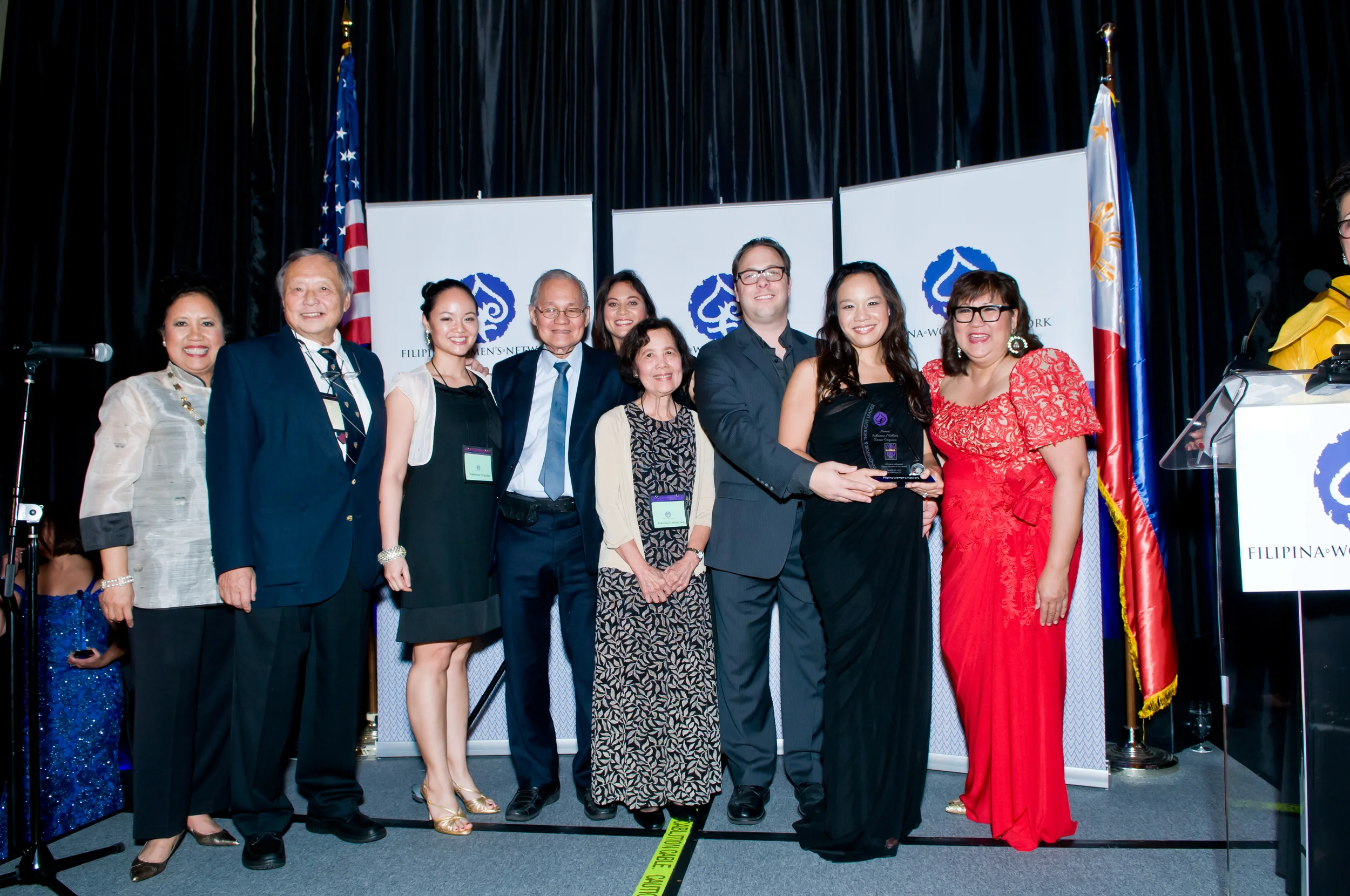
Melissa Orquiza (Global FWN100™ '15) and family pictured with Filipina Women's Network's Elena Mangahas, Board Chair, Susie Quesada, President and Marily Mondejar, CEO at the Global FWN100™ Awards Gala, 12th Filipina Leadership Global Summit, October 29th, 2015, San Francisco, California.
I thought more seriously about this issue when I realized the recent growth of Filipina American writers in literature such as Mia Alvar and Jessica Hagedorn. The literary world has wholly embraced the immigrant narrative from the Philippines. Why has the classical music community failed to do the same? Was the lack of Filipino composers never addressed within the Filipino community? The more I dug, the more I realized the answers of what constitutes Filipino music or native Filipino music led to more questions. The question was not just about the anthropological study of Filipino ethnomusicology, but encompassed bigger questions concerning immigration, colonization, assimilation, racism, and social stratification.
There is an interesting quote from, The ‘Round the World Traveller by D.E. Lorenz, PHD from 1925, that insightfully described how Filipinos were perceived at the time Nicanor Abelardo was composing.


Please keep this all in mind while I continue.
As a Filipina, grappling with cultural identity in the arts, my biggest strength is my insatiable curiosity. I feel that the problem solving skills in mathematics, neuroscience, and science, apply completely to the complexities of the musical arts. Hence, my biggest musical problem I’ve encountered.
Two years ago, while accompanying my mother to attend my uncle’s funeral in Quezon City, I arranged to visit the music department library at the University of the Philippines, Diliman. My late uncle was a professor and secretary at the law school and one of the last things he did for me was photocopy hundreds of pages of Filipino songs to play through. As I sat down to study these hundreds of pages, I was becoming increasingly frustrated to see all the songs that were given to me sounded like Spanish cancions and Western songs. Basically, what constituted Filipino music, according to the collection of the U.P. library, sounded like parodies of Spanish love ballads, tangos, American ragtime, or jazz. Why had the library overlooked indigenous native songs when so many European composers celebrated their folk songs and documented them in classical music? Beethoven, Mozart, Brahms, Bartok, Liszt, and Chopin all incorporated folk songs and are in the classical music canon. Why hadn't the same thing happened for Filipino classical composers?
I asked myself, should I have gone to a fiesta instead to truly understand Filipino music? Would that have given me a more inclusive representation of the music from a country fraught with cultural disparities? How did a nation that is a haven to so many religions, tribes, and languages have an entire written musical identity distilled into something so elementary? It’s as if you heard a song on the radio, then someone wrote it out for a piano and singer; and those songs were the exemplification of a nation’s musical identity. It’s not only grossly unfair and oversimplified—the questions within the framework of Western classical music weren’t even asked.
Then, I realized the musical infrastructure itself had not supported or encouraged young talented musicians to this classical Western symphonic path, even though the country itself had been ruled by Spain for more than three hundred years. Even Latin American countries, once also colonies of Spain, today have classical, orchestral composers. You don’t have to look far.: Gustavo Dudamel, the conductor of the LA Phil, is a product of this Spanish classical infrastructure as a native of Venezuela.
The valuation of music in Filipino society was not the primary problem. Almost every Filipino I know can do something musical; it’s the primary way of interacting behind food. Even in the smallest villages, people sing, play the guitar and the piano. Many “untrained” singers have perfect pitch but don’t even realize it. When cruise ships in the mid-twentieth century needed Western music players, they didn’t go to China and Japan. They sought performers from the Philippines because they could feel and play Western music. Then, I realized it immediately.
The problem was lack of opportunity and resources in the Philippines. Talented musicians were getting exported out of the country the same way Filipino workers in healthcare, engineering, service, and labor are today.
With additional research in conjunction with one of the lead scholars in Filipino and US 20th century history, René Alexander Orquiza, Jr. (a Harvard professor who happens to be my little brother), I came to the realization that these questions needed to be asked. Dare we say, they had never been asked critically before.
I am currently working on symphonic transcriptions of native Filipino music, composed, arranged, and translated for symphonic orchestra. Most metropolitan orchestras feature either an Asian composer on their programming or an Asian Cultural celebration. In Los Angeles, the Hollywood Bowl programmed a Filipino Musical Night that consisted of choir, vocalists, and pop groups. The Hollywood Bowl houses two orchestras: the Los Angeles Philharmonic and the Hollywood Bowl Orchestra. The question here did not concern resources with the venue. There were no iconic classical Filipino composers whose music they could play.
My hope is that in the future, when symphonies around the world program “Asian” or “Spanish” music, that the Philippines will be included in that dialogue. Why can’t you go to the symphony and see a Filipino composer’s name on the program?
I’m not here to tell the WAY you should affect change. Every one of these FWN awardees bring their own talents, personalities, and strengths to the Filipina narrative. I’m here to help you question how you PERSONALLY can affect change. And by that, what is it about YOU that is unique? What has happened to you in the past that has made you stronger? What has happened to your mother, your sister, your grandmother, your aunt, your best friend, that has helped form the decisions you have made? As an artist , I grapple with these questions everyday. Emotions are universal and integral to good storytelling in movies and television.
From FWN alumni, Dr. Connie Mariano, who was the physician to Bill Clinton to Keesa Ocampo, the corporate affairs officer for ABS- CBN International and continual philanthropist, to Thelma Boac, one of the few Filipina high school principals in the Bay Area and a leader in civic education, to business woman and grassroots organizer, Marily Mondejar, founding president of the Filipina Women’s Network, who is currently running for the Democratic county central committee in SF, to Gloria Caoile, a pioneer in Filipino civil rights, and the founder of the Asian Pacific American Women Leadership Institute, the only national organization dedicated to nurturing and developing leadership skills among Asian American and Pacific Islander women, you do not need to be a filmmaker to communicate what makes us uniquely human and to pass your insight unto the world.
What is it about you that can spark happiness, insight, love, and optimism in others? You need to protect that spark with everything you have. Do not let others tell you you need to change that spark. Only you know what is unique to you and oftentimes, it was a hard event that seemed insurmountable but made you the person you are. Celebrate it. Do not let that fire burn out. That experience, that hurt, that scar is what will give you the strength to affect change. You can affect change everyday by being the best person you can be.
You do not need to be rich, intelligent, famous, or well connected to affect change. You can be a service worker and affect change. You can be a CEO and affect change. You can be a nurse and affect change. You canwork in the police department, like my sister Vanessa, and affect change. You can be a high school student and affect change. But, the only way you will have the strength to stand up to the status quo is to know and celebrate what is unique about you. You can be quiet, you can be loud. You can be aggressive or you can be easy going. There is only one you, and you owe it to yourself, to your family, to your community, and to others to be the best, kindest, strongest, fairest, person you can be. When others see YOU have the strength to question and to follow through, whether you are a CEO or a domestic worker, others around you will question the status quo. You will affect change because YOU ARE CHANGE.
Let me repeat this. You will affect change because YOU ARE CHANGE.
With that said, let’s welcome our leaders of change. The 2015 Global FWN100 awardees.

Working with women can be a tricky business
Lilia V. Villanueva (U.S. FWN100™ '07) reflects on her tenure as a member of the 2009 U.S. FWN100™ Selection Committee.
After the 2009 Filipina Leadership Summit in Berkeley, Lilia V. Villanueva (U.S. FWN100™ '07) reflected on her tenure as a member of the 2009 U.S. FWN100™ Selection Committee.
(Top Image: Lilia Villanueva at her family's ancestral home in Bacolod. Photo Credit: The Bacolod Food Hunters)
Working with women can be a tricky business. I know a lot of women who openly declare that they prefer working with or for male rather than female bosses. I never shared this sentiment; I’ve had my fair share of tyrannical female bosses who needed to be so in order to keep their position in the power pecking order of corporations or non-profits.
I felt sympathy for these women—they’ve worked doubly hard to get where they wanted to be, only to be hated by their fellow womenkind. Women, who, if possible, stay away from other women in the workplace, do so for reasons such as: women gossip, they get jealous easily, they’re stricter as bosses and won’t give any slack, they’re bitchy and moody.
In 2009, I’d like to think that we, who grew into adulthood during the nascent period of the women’s liberation movement in the U. S., have gone past the traditional reasons for avoiding working with women. As past president of Asian Women United of California for several years, I’ve had many opportunities to work exclusively with women in non-profit organizations and projects, and have yet to synthesize why I feel blessed for having belonged to a very strong and good cabal of sisterhood.
In the last couple of years, I’ve had the privilege of joining the Filipina Women’s Network, and served on the Selection Committee for the 2009 100 Most Influential Filipinas in the U. S. There are a dozen committee members, and many of us have not met or seen each other for a couple of years since the 2007 Summit in Washington, D.C.
When FWN President Marily Mondejar asked me to join the Selection Committee, I agreed to serve because I know that giving back to organizations that work on and for my behalf deserve my time of day and more. Lucky for me, the majority of the Committee members are more techno-savvy than I, and therefore, efficient and organized.
FWN board members have taken to heart lessons learned from the previous Summit, and our Committee, headed by Shirley Raguindin and Ellen Abellera, functioned as smoothly as one would expect, given that members lived on several states on both coasts. The weekly teleconference meetings were prompt, efficient and ended on time! Amazing. And we weren’t all business either. Friendly banter was tolerated and relaxed everyone who, for the most part, only knew each other through voices.
Being on the Committee provided me with an opportunity to ‘meet’ other talented and wonderful women—the nominees, which each committee member was assigned to interview. I spoke with ten Filipinas I’ve never met or known of before, discussed their careers and aspirations, and always came away feeling good about being part of them—fellow Pinays, living in this country. It was a good feeling, and I benefited from feeling the closeness, even for just a few minutes. With some, we promised to visit each other when they’re in my city (New York), or I in theirs.
Yes, a kinship born from working with an organization that fosters networking and supporting each other because we, as Filipinas in the U. S., do have a voice and can exercise it if we want to.
Thank you, fellow Selection Committee members and Marily, for the privilege of working with you!
Lilia V. Villanueva (U.S. FWN100™ '07)
Art & Interiors Gallery Owner – TAMA Gallery
New York City
2009
More about Lilia V. Villanueva (U.S. FWN100™ '07)

Janet C. Mendoza Stickmon Reflects on the 2013 Filipina Leadership Global Summit
Janet C. Mendoza Stickmon (Global FWN100™ '13) shares her thoughts and experience at the 2013 Filipina Leadership Global Summit held in San Francisco, California.
Receiving her Global FWN100™ Award as Innovator & Thought Leader, Janet C. Mendoza Stickmon (second from right) is joined by (from left) FWN President Susie Quesada, Vangie Buell (US FWN100 '07), FWN Founder & CEO Marily Mondejar and FWN Chair Elena Mangahas. The Global FWN100 Awards™ Gala was held on October 26, 2013 during the 10th Filipina Leadership Summit in San Francisco California.
The following was sent to Marily Mondejar and the FWN Board and is shared with the author's permission.
I know we didn't have much time to talk during the FWN Summit, but I just want to tell you how much I was completely transformed by all the events that weekend. From the shuttle rides, to the workshops, to the meals and ultimately the Gala, I felt a strong bond with Filipinas around the world like never before.
I found myself reflecting constantly about my mother (originally from Cebu) and all that she sacrificed for me. She passed away when I was 15 and seemed to have sent me a new Mom … a mom of my adulthood—Mama/Auntie Vangie, who has opened me up to an even larger network of strong, proud, intelligent Filipinas. I am so proud to be recognized by this organization as one of these strong & influential Filipinas. What an honor!
By how professional and well-organized (and detailed) the summit was and how elegant the Gala was, I became convinced that it is truly the communities we represent and the communities we serve who can recognize our accomplishments in a way that is most meaningful to us. We may not always get the recognition, the accolades, or the respect we deserve from the institutions we work for.

Janet singing with her daughter.
Long ago, I made the decision never to sacrifice my health or compromise my identity for any institution. This had resulted from having devoted 7.5 years of my life to a Catholic high school, having an enormous influence on hundreds of students' lives, only to have my heart broken by the institution several times by racism, neglect, and scandal.
For my 7.5 years of service (though I did receive Teacher of the Year award around my 5th year), I was never given a formal farewell from the faculty/administration in ways that other faculty would be honored/recognized during a school assembly or graduation ceremony. I felt exploited. Not by the students, but by the institution.
It wasn't that I only wanted to serve on condition that I receive an award. I think this goes without saying, but I'll say it anyway: most certainly my love for students and the energy I put in the classroom instruction was not driven by the possibility of receiving awards. Truly the most enriching reward was my students' laughter and tears and seeing my students come back years after they've graduated to tell me about their lives.
That was 2006. Since then, I have been careful not to expect an institution to honor my work in the way that I believe I deserve. In a sense, an institution can never truly know exactly what sort of blood, sweat, tears, anguish and love is required of women of color on a daily basis.
Though I am extremely grateful that I am in a much better place now (at Napa Valley College), in a much better/healthier division, (the Arts and Humanities Division) surrounded by people within that division who have a far, greater respect and appreciation for the work I do than ever in the past, this wonderful recognition is still unmatched when compared to the recognition I felt at the FWN Gala and the beautiful exchanges I had with the women during the FWN summit—an event organized by Filipinas who understand the blood, sweat, tears, anguish and love of expended by Filipinas in the public and private sector.
Lastly, I thank you for this concept of the FWN GlobalAward 100 being a "working" award. This was made so clear throughout the weekend and particularly during the speeches at the Gala (as I reflect particularly on the speech of Cora Tellez).

Janet and her family
Instead of FWN being some insular, secret society, it is an organization that wants to continuously recognize the accomplishments of Filipinas worldwide and reach out to and become models for young Filipinas to ensure their success and well-being. It wants to expand its circle to include more and more accomplished Filipinas with each year that passes, reminding its members of their responsibility to continuously reach out and femtor others.
The organization, while recognizing 100 awardees each year, still remains conscious of the fact that there are many Filipinas out there (who may not be official awardees) who are nonetheless doing great transformative work that deserves to be recognized; thus, this becomes the impetus for us to grow, femtor, and turn our awards into "working" awards.
Marily, I thank you so much for founding FWN ten years ago, and thank you to the organizing committee and board for all they have done. I look forward to becoming a member and attending the next FWN Summit and seeing Susie Quesada in action as the new president. I think this organization becomes a fabulous model for other communities of color and other marginalized communities whose work tends not to be publicly recognized.
My sincerest thanks.
Janet C. Mendoza Stickmon is the Founder of Broken Shackle Developmental Training and the
Professor of Humanities, Napa Valley College in Napa, California. She can be reached at jstickmon [at] gmail [dot] com.