

HON. Cynthia Alcantara-Barker: Acceptance Speech on behalf of the Most Influential Filipina Women of the World 2017
Brookmeadow, Elstree & Borehamwood Town Councillor and Hertsmere Borough Councillor Cynthia Alcantara Barker (Global FWN100™ 2017) delivers the Acceptance Speech on behalf of 2017's Most Influential Filipina Women of the World.
"If our stories can reach the ears of school girls in the Philippines, my hope is that they will say, “Wow, I can do that too!” Our challenge goes beyond us adapting to the changing world. It goes beyond simply teaching others how to do it. Our challenge is to encourage and lead them to take action!"

Brookmeadow, Elstree & Borehamwood Town Councillor and Hertsmere Borough Councillor Cynthia Alcantara Barker (Global FWN100™ 2017) delivers the Acceptance Speech on behalf of 2017's Most Influential Filipina Women of the World.
Below is the full text of her Acceptance Speech.
I am incredibly honoured to be here tonight, in the company of the Most Influential Filipina Women in the world.
Receiving this Filipina Women’s Network Award is extra special because it recognizes all of us, Filipina women, as leaders in our respective fields.
I am deeply humbled to have been tasked to deliver this Acceptance Speech on behalf of the 2017 batch of remarkable Filipina minds, personalities and achievers.
When I was asked to deliver the acceptance speech, Marily Mondejar gave me the challenge to keep to the theme of leading, inspiring and advocating. My first thoughts were - my goodness, what can I possibly share when I know you are all leading, inspiring and advocating on a daily basis. But then I thought about it, I realized we have another thing in common - that in our lifetime, we have a role model who inspired us to become who we are today.
Allow me take you back to my childhood.
I grew up in San Pablo City in the Philippines. I thought my life would be simple and idyllic growing up and growing old in the province. But two people challenged my aspirations. I looked up to them, both school teachers – my parents, Inay at Tatay.
When I was growing up in the 70’s, the pay for two full time school teachers was not enough to support a family of 5 children. I was too young to understand how the decision was made but they decided that Inay would seek a better future for us by taking a giant leap into the unknown and find work opportunities in the United Kingdom.
My father agreed to look after us and to ensure we continue our education. And I would like to acknowledge that as a teacher, my father understood the value of education for women, not just for the boys.
I looked up to my parents because of an important life lesson they showed me and my siblings - to value education and continuous self improvement. I learned that no matter what I do in the future, I should consistently keep moving.
Passed an exam? Keep moving.
Made it through an interview? Keep moving.
Got your dream job? - keep moving.
Don’t waste the chance to do more.
Eventually, all 5 children migrated to foreign lands. We kept moving forward. But now as I look back, I can fully appreciate the fact that because my parents taught the value of moving forward, I have done some good in this world.
I am sharing this with you today to remind us to keep moving.
But you know what, as we gather here tonight and as prestigious as this Award is, I can hear my mother’s voice in my head, saying keep moving.
Keep moving. I made it my mantra.
If our stories can reach the ears of school girls in the Philippines, my hope is that they will say: “Wow, I can do that too!”
Our challenge goes beyond us adapting to the changing world.
It goes beyond simply teaching others how to do it.
Our challenge is to encourage and lead them to take action!
We attended the Learning Journey and workshop yesterday where we acknowledged the importance of advocacy. And we understood that advocacy cannot happen without excellent networking. I hope we can channel these events - this year’s successes - into a positive networking force that can move others to change and inspire the world. Only then can we truly say that we have made an impact.
So tonight, I am excited by the thought of 2018 and I look forward to welcoming all of you, to the London Summit, to celebrate 15 years of the Filipina Women’s Network, in preparation for the Pinay Power Reunion in Washington in 2020.
And as we congratulate ourselves, so we challenge ourselves.
Let us keep moving together.
Thank you, magandang gabi sa inyong lahat, mabuhay, salamat po.

Wilma "Amy" T. Eisma: My Journey to Leadership
Subic Bay Metropolitan Authority Chair and Administrator, Wilma "Amy" T. Eisma (Global FWN100™ '17), delivers the Leadership Keynote at the 14th Filipina Leadership Global Summit held in Toronto, Canada on October 27, 2017.
"Malasakit is what compels us to embrace and take up the plight of one as our very own, to expand our concern and sense of responsibility beyond our own backyard to include the rest of our community and our environment. Malasakit also drives passion and excellence. We work with passion and the desire to excel because we intensely care about what we do and how we do it. It prompts us to give better than our best to anything and everything we do."

Subic Bay Metropolitan Authority Chair and Administrator, Wilma "Amy" T. Eisma (Global FWN100™ '17), delivers the Leadership Keynote at the 14th Filipina Leadership Global Summit held in Toronto, Canada on October 27, 2017.
Below is the full text of her Leadership Keynote.
Magandang gabi, Mabuhay ang Pinay Power!
Taking up the challenge
My journey to this moment of honor actually began when I decided to walk up to Dick Gordon who was then Chairman of the Subic Bay Metropolitan Authority (or SBMA) to join his corp of volunteer for the conversion of the former US Naval Base to a freeport despite the fact that my father is from the opposite political fence.
The boss as we call him, accepted me not just in his staff but even let me in in his inner circle.
Aiming high and staying grounded
And boy, did the inner circle made me cocky.
Imagine, a 22 year old fresh graduate from the Ateneo Law School, working side by side with the founding Chairman of SBMA, riding helicopters, negotating contracts with the World Bank, joining business missions all over the world.
I was on top of my game, or so I thought.
The I flunked the bar.
It was the most trying time in my adult life. It was also the time where I got my first real lesson in life.
The lesson to move on and fight back when life knocks you down. The lesson not to dwell on the failure but how to stand up and move on. The lesson that I can never be cocky ever again.
And so after my stint as volunteer and as lawyer for SBMA, I moved to the private sector and for 15 or so years learned international corporate business practises, won awards and accolades and honed my craft which I bring and use in my job today.
Subic Bay Freeport
Then Philippine President Duterte appointed me as Administrator and CEO of the SBMA in December 2016 and eventually as its Chairperson and Administrator.
It was a job I never asked for asked for, lobbied for or applied for. In fact, I even made a pilgriamage to Our Lady of Manaoag so I will not to get it.
When I got the fatal call, that pit in my stomach told me it was destiny. I told myself that the Universe must be telling me something.
Being born, bred and raised in Olongapo City, I thought the message was, it’s time to come home. And so I did.
Moving to a 25-year old government bureaucracy was a jolting experience. Unlike other appointees, I did not bring to SBMA my own personal staff. Doing so would mean that I judge them to be incompetent and demoralize the ranks. Instead, I only brought me and myself alone.
Because to me, my job is clear: to provide leadership and vision, moral compass and heart. I also brought with me my values for hardwork, work ethic, integrity and passion. The one thing that I did not bring is a personal agenda.
My only agenda is to help my community, my home, and for my people to have a better life
Unfortunately the road is not paved with gold. At the outset, I found myself in loggerheads with those whose agenda is questionable. It was tough and I thought I really do not need this crap. I wanted to take the easy way out and quit.
However the overwhelming love and support of my people, my board of directors, the local and national government leaders, even strangers, made the difference in the choice between the quitting and fighting on.
As they say, the rest is history.
I came up on top and now am here, with a mandate as Chairman of the Board and Administrator/CEO of SBMA. The real work has began.
As I said I did not bring anything lofty or fancy dreams to SBMA. I am not promising high tech, or bridges or tall buildings.
I rather that we bring back what we lost in the last 25 years. To go back to basics. The meaning of true service. To give back when there is nothing else to give.
Build, build, build
If “Build, Build, Build” is the main focus of the Duterte administration; in Subic Bay Freeport and at SBMA, I have my own “Build, Build, Build”.
But it is not physical infrastructure, but soft ones like jobs, skills, employee morale, work culture and ethics, core values, services, good governace, malasakit , and a quality of life my people and our children deserves.
So, what other lessons have I learned and am I still learning along the career path I have chosen?
A lot, I would say but for tonight, I have three major take-away points that I would like to share.
No. 1: Power is a challenge and a test of character and leadership.
Heading a complex government agency like SBMA, with 2,600 employees, is challenging enough.
But even more so is managing the Subic Bay Freeport –with its own seaport, airport, 1,699 local and foreign investors and US$9.1 billion worth of investments employing over 121,800 Filipinos.
Despite these challenges, my post is much-coveted because it brings with it power and prestige, not to mention dominion over 67,452 hectares of land.
This can be overwhelming and intoxicating.
If you ask me, the reason why some government officials feels entitled is because the Filipino culture of innate sense of respect, kowtowing to figures of authority and refer to them by their honorific titles, unwittingly cocooning them in a false yet heightened sense of self-importance.
Little do they realize that the manner with which they wield their power reveals their true character just like the emperor who wore no clothes.
With my short stint to date, I realized the most important lesson that I should never forget is that “Those who have the most power should be the most humble”
Yes, power is a challenge. How one handles power is a test of character and one’s brand of leadership.
It is important to stay humble. ALWAYS.
No. 2: Leadership is service and the foundation of meaningful success.
But true leadership is not about power. It is about service.
While it is true that success can bring fame, glory, and wealth, success to be truly meaningful must be founded on service, the kind that cannot be bought or measured with money. This kind of service is what drives me today.
As you all know, government is a poverty job but it came at a time in my life when I no longer need a fourth Rolex to be happy. At this point, the legacy of my father’ last name is all I care about. To support my team. To inspire and be a man for others.
At the end of the day, knowing that I made life better and brighter for my people, or that I have done well by my father’s name is what matters most.
No. 3: Genuine service begins with malasakit.
The last and, I would say, most important lesson I have learned in my career is that a strong sense of service begins and ends with the Filipino value of malasakit.
This is why Filipinos here and elsewhere are much valued in any kind of work setting –that requires customer attention and care.
In other words, we serve because we care with compassion and nary a thought of the cost to ourselves.
Malasakit was the driving force that brought some 8,000 volunteers to help secure Subic when the US Naval Base was turned over to the Philippines.
Without thinking of remuneration or personal comfort, they unselflishly gave of themselves and took up the struggle of creating a new Subic as their own, simply because they cared.
I should know because I am one of them.
I was among those volunteers who flocked to Subic, coming from all walks of life and places and whose malasakit was as palpable as the thick blanket of smoke and ashes that covered our community when Mount Pinatubo erupted in 1991.
To the non-Filipinos in the audience, no English translation for malasakit comes to mind. The closest English word I can think of right now is empathy but malasakit means more than that. It is more than just a strong sense of civic duty because malasakit comes from a sense of oneness with whoever is in need without being asked or compelled to. It can be as ordinary as picking up a trash from the sidewalk – not because civic duty compels us to do so but simply because we love and care for our community. Perhaps altruism is a more fitting translation because altruism can only spring from a deep-seated desire to be of help and value to someone else.
In other words, malasakit is what compels us to embrace and take up the plight of one as our very own, to expand our concern and sense of responsibility beyond our own backyard to include the rest of our community and our environment.
Malasakit also drives passion and excellence. We work with passion and the desire to excel because we intensely care about what we do and how we do it. It prompts us to give better than our best to anything and everything we do.
Noblesse Oblige
The French has a phrase that captures everything I have learned and shared about power, leadership, service, and malasakit...
Noblesse Oblige, which literally means "nobility obligates". Today, it means that those with power should extend themselves and use their position to help others because they have the means to do so. The more privileged we are, the bigger and heavier is our responsibility toward the less privileged. And the more humble and grounded we should be.
Because of the position we hold in our respective careers and areas of endeavor, we have the power, the leadership, and the means to advocate on behalf of the less privileged, to impact on their lives, especially those in our home country. This, I believe, is the challenge behind tonight’s theme, “LEADING. ADVOCATING. IMPACTING.”
To wrap up, I would like to repeat what I said in in my time capsule video: To lead and achieve success, we should do everything with integrity and character, passion and love.
Because how else can we lead and bring value to our work without integrity and character?
Without passion, how else can we achieve success?
Without love, how can we be happy with success and serve others?
Maraming salamat po at mabuhay!

H.E. Petronila P. Garcia: Welcome Keynote at the 14th Filipina Leadership Global Summit Gala Awards Ceremony
Philippine Ambassador to Canada, H.E. Petronila P. Garcia (Global FWN100™ '17) delivers the Welcome Keynote at the 14th Filipina Leadership Global Summit Gala Awards Ceremony held in Toronto, Canada on October 27, 2017.
"Let us draw inspiration from [our Awardees] and share their experiences to the next generation of Filipina women leaders. We have long broken the glass ceiling in the Philippines when we chose Corazon Aquino as our first lady president. Let us help women in other places break the glass ceilings which have prevented them from reaching the pinnacle of economic and political power in their respective countries."

Philippine Ambassador to Canada, H.E. Petronila P. Garcia (Global FWN100™ '17) delivers the Welcome Keynote at the 14th Filipina Leadership Global Summit Gala Awards Ceremony held in Toronto, Canada on October 27, 2017.
Below is the full text of her Welcome Keynote.
Distinguished guests,
Colleagues in government,
Ladies and Gentlemen,
Mga Kababayan,
I wish to congratulate the Filipina Women's Network for bringing us together tonight to honor the most influential Filipina women in the world.
Chinese leader Mao Zedong said it correctly that "women hold up half the sky!" I worry, however, that with the attendance of Filipina leaders and organizers tonight, nobody is left to run your companies, offices, business establishments, and homes. But let your menfolk wait. This is our night to honor and recognize those among us who have led the way in opening new doors, pushing new boundaries, and challenging dated beliefs to benefit all women.
Permit me momentarily to invite those among you who have not registered for the Philippine overseas elections in 2019 to do so at your nearest consulates or embassies. And for those looking forward to escaping the harsh winters of Canada, to immediately sign up for the Winter Escapade scheduled in February next year where I will be accompanying you to historic Manila, bucolic Bacolod, and the center of political power, Davao City. Please visit the website of the Philippine Embassy or the Philippine Consulate General in Toronto for further details.
Ladies and Gentlemen,
We often hear people say that we live in trying times. We hear of fears over climate change, wars, and health epidemics which threaten humanity and the world. This is, therefore, the opportune moment for women in the world, particularly Filipinas, to step up and lead.
We also often hear the adage that behind a successful man is a woman. But we have seen prying eyes looking at past successes to determine whether it is the woman who was really responsible and not the man. There were indeed instances when the hard work of a woman had to be claimed by her husband in those times when the place of the woman is strictly in the home.
Those times, however, have long since gone. For every achievement that a woman reaches, she can now stand alone in the limelight and claim credit for these and receive the congratulations of those who benefit from them. And the husband would, of course, still be there to drive her home.
Seriously, we are living in a world connected by the internet and the web. Artificial intelligence is now seeping into many facets of our workplace and home. Moment is measured in the present. Time is appreciated in the now. What would seem like a serious advancement in thought and technology would become obsolete in a matter of weeks, days, or even seconds. We are pushing ourselves to achieve instant gratification, instant success. But we must remind ourselves that our successes do not happen in a vacuum. We, too, are influenced by those who are around us, those who have been there before us. It is always a welcome opportunity to momentarily escape from the pressures of the world to gather together and celebrate each other's success. To learn from each other. To inspire one another.

Ambassador Petronila Garcia (Global FWN100™ '17) delivers the Welcome Keynote at the 14th Filipina Leadership Global Summit Gala Awards Ceremony.
Ladies and Gentlemen,
Tonight, we recognize the achievements of Filipinas around the world. Those who have been chosen are not, by any means, the only successful Filipinas, but they are representatives of those many others who could not be with us.
The definition of success is subjective. Some measure it in dollars and cents. Others would count the number of awards and certificates. Still others will look at the number of academic degrees earned and the number of successful businesses established. For some, their success is shown in having raised a caring and healthy family even if they are not blessed with material wealth. I am sure we are not here to debate the definition of success, nor to limit its scope. We are here to celebrate all manifestations of success.
Those fortunate to have been selected as awardees tonight should serve as inspirations to all of us. In their way to achieving recognition and influence, I am certain that each faced unique challenges which could have dissuaded those of weaker souls. Only by confronting and conquering those challenges were they able to rise to their chosen pillars of society and stand able to influence those who follow behind. Allow me, therefore, to share with you this important trait of perseverance and persistence.
Each journey we take starts with the first step. Whether we reach our destination or not depends on whether we commit to take those additional steps necessary to allow us to reach our goal. Each step is a decision only we can take. Each step is only ours to make. Some of us gets distracted and choose to stop. Others lack motivation to continue. Our success in reaching the end of our journey depends primarily on ourselves. We cannot blame others for our failure. We make the decisions. Our being women is not even a consideration. We need to wake up those among us who believe that women are created to be inferior to men. These are modern times. When we persevere, when we persist, success would certainly be within reach.
Ladies and Gentlemen,
As the first Filipina woman ambassador to Canada and the first Filipina woman ambassador in the Middle East, I have countless stories to share about the challenges I have faced. But tonight is not the time to tell you those stories. Tonight is the time to celebrate the successes of our awardees.
Let us draw inspiration from them and share their experiences to the next generation of Filipina women leaders. We have long broken the glass ceiling in the Philippines when we chose Corazon Aquino as our first lady president. Let us help women in other places break the glass ceilings which have prevented them from reaching the pinnacle of economic and political power in their respective countries.
We are Filipinas. We are leaders. And we shall lead others.
Maraming salamat po at mabuhay ang mga Filipinas!
Undersecretary Nora Kakilala Terrado: Updates on the State of the Philippine Economy
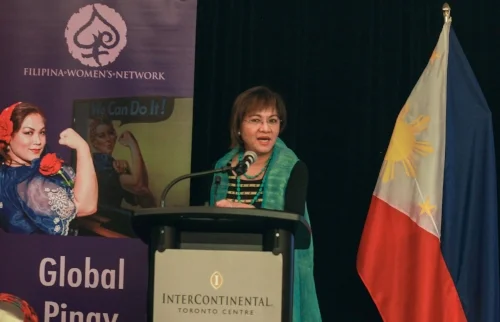
Philippine Department of Trade and Industry Undersecretary Nora Kakilala Terrado (Global FWN100™ 2014, Global FWN100™ 2016) delivered her keynote on Updates on the State of the Philippine Economy at the 14th Filipina Leadership Global Summit held in Toronto, Canada on October 27, 2017.
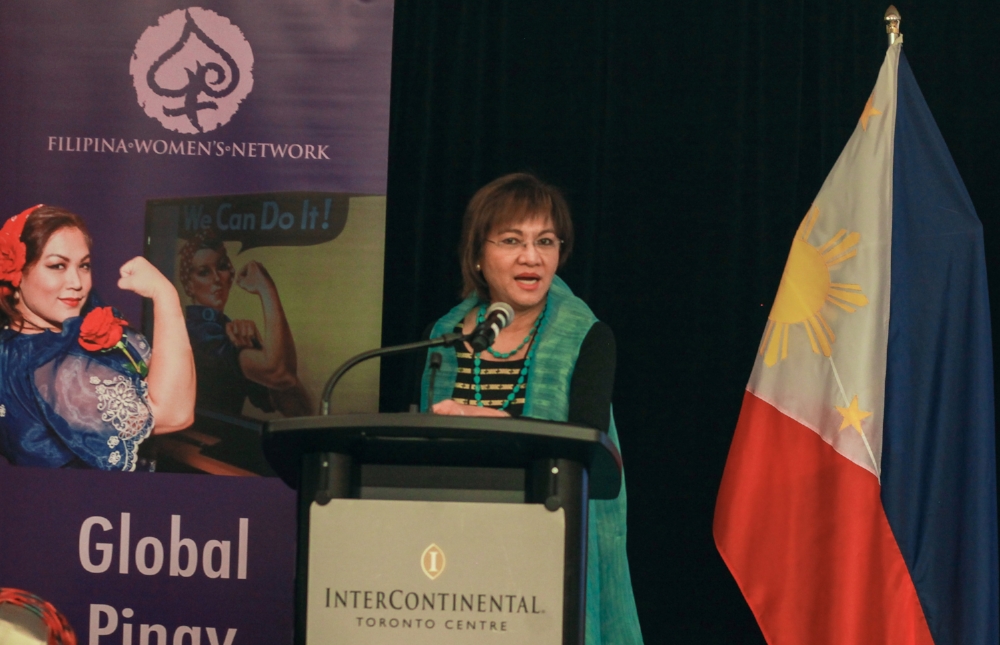
Philippine Department of Trade and Industry Undersecretary Nora Kakilala Terrado (Global FWN100™ 2014, Global FWN100™ 2016) delivered her keynote on Updates on the State of the Philippine Economy at the 14th Filipina Leadership Global Summit held in Toronto, Canada on October 27, 2017.
Below is the full text of her keynote speech.
A pleasant morning to everyone.
It is my pleasure to meet you all and present the many positive developments in The Philippines. I am here to encourage those of you who are on the lookout for the best investment opportunities available and assure those who have already invested that our ountry’s growth is permanent and sustainable.
Kindly allow me to reaffirm today that The Philippines is open and ready for more of your business.
The Philippines: The Bright Spot in Asia
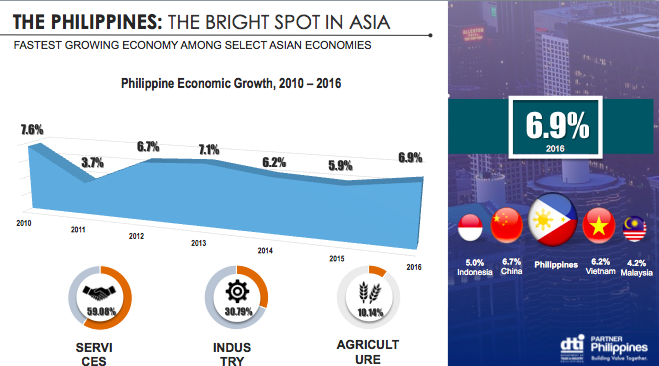
In this regard, I wish to emphasize that The Philippines continues to be a prime investment destination not only in the ASEAN region but in the world. This strong investment position is due in large part to the Philippine economy’s continuing robust performance after proving its innate resilience in the face of global uncertainties.
From 2011 to 2016, The Philippines’ gross domestic product (GDP) recorded an average growth rate of 6.1 percent.
In 2016, The Philippines was the fastest-growing economy among selected Asian economies, posting a robust 6.9 percent growth in GDP, surpassing China (6.7%), Vietnam (6.2%) and Indonesia (5.0%) and Malaysia (4.2%).
This is a strong affirmation that our economy is indeed steadily traversing a high growth path, ascending on the solid efforts by both public and private sectors.
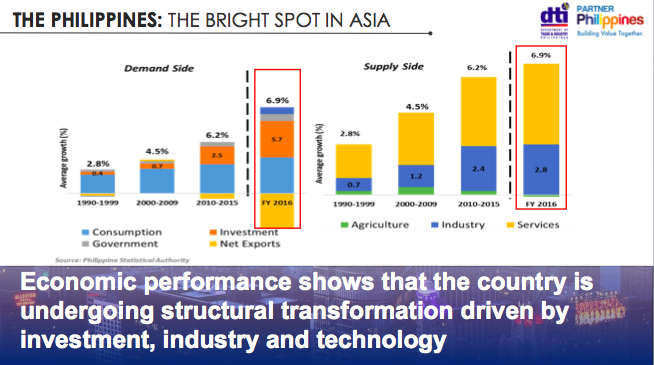
The economy is also undergoing structural transformation. This means that growth is increasingly being driven by investments vis-à-vis consumption, and led by the industry sector relative to the service sector. In other words, sources of economic growth have broadened. Such qualitative change of the economy is crucial to sustaining growth and generating more stable quality jobs.
Total factor productivity (TFP) growth of the economy in recent years has been the fastest in ASEAN, at 2.3 percent. Which also means that capital efficiency (incremental capital output ratio or ICOR) has been improving)
These suggest that economic growth is sustainable, thereby capable of generating more stable and gainful jobs.
The Philippines is one of the world's fastest-growing countries. Real GDP should increase by 6.3% in 2017 after gains of 6.9% in 2016. Robust growth in private final consumption and an increase in public spending on infrastructure (predicted to be 5.8%) are the main drivers. Improvements in investor confidence and rising FDI provide additional support.
The real value of private final consumption rose by 6.5% in 2016 and an increase of 6.4% is expected in 2017. Steady growth in employment and public sector spending provide support

Table 1 details the sources of growth or where growth is coming from.
On the supply or production side, growth in the services sector improved to 7.4 percent, and industry grew 8.4 percent in 2016. However, agricultural growth was a letdown as it reverted to negative territory in the fourth quarter, and for the whole of 2016, reeling from the effects of typhoons “Karen” and “Lawin”. If not for these typhoons, real GDP growth could have hit closer to 7 percent in 2016, as we had hoped.
Domestic demand continued to fuel growth throughout 2016. A robust expansion in investments, growing 25.2 percent in 2016. Public investment in infrastructure remained strong with public construction growing by 28 percent. Private consumption grew 7.0 percent in 2016. All this is attributed to high consumer confidence, modest inflation and interest rates, and improving labor market conditions.
External demand expanded by 10.7 percent in 2016, with merchandise exports rising by 9.2 percent and exports of services maintaining its double-digit growth of 16.2 percent. Growth in imports likewise accelerated by 18.5 percent for the year, reflecting higher purchases of capital and durable goods, which indicate business and consumer confidence, and sustainability of growth.

Growth of the country’s real gross domestic product (GDP) accelerated to 6.5 percent in the second quarter (Q2) of 2017. This is faster than the 6.4 percent growth in the preceding quarter, albeit slower than the 7.1 percent growth in the same period in 2016. Growth in the second quarter of 2017 was in line with the expectations of the market given the 6.5 percent consensus median estimate. This puts the country to be well on track in meeting the lower-end of the full year target range of 6.5 to 7.5 percent GDP growth for 2017.
Gross national income (GNI) growth likewise improved to 6.8 percent in Q2 2017 from 6.2 percent in the previous quarter, albeit still slower than the 7.0 percent in Q2 2016. The acceleration in GNI is supported by the marked increase in net primary income (mainly compensation income) at 8.6 percent. This is faster compared to the 5.4 percent in Q1 2016 and the 6.1 percent recorded in the same period of 2016.
On the supply side, the service sector is still the main driver of growth despite posting a deceleration for the period (+6.1% from +6.7% in Q1 2017 and +8.2% in Q2 2016). Meanwhile, the industry sector recorded marked improvements (+7.3% from +6.3% in Q1 2017 and +7.6% in Q1 2016), supported by the faster expansion in the manufacturing sector, and partly due to the rebound in the mining and quarrying sector. The agriculture sector, which accounts for about 26 percent of total employment, continues to show sustained growth and posted gains (+6.3% from +4.9% in Q1 2017 and -2.0% in Q2 2016) in the second quarter following the increase in production in the cereals and poultry sector.
On the expenditure side, domestic demand slowly gained traction in the second quarter of the year (+6.7% in Q2 2017 from +6.5% in Q1 2017 and +13.0% in Q2 2016), mainly sustained by private consumption and a recovery in government spending. Consumer spending was up slightly to 5.9 percent in Q2 2017 (from +5.8% in Q1 2017 and +7.5% in Q2 2016), supported by record high consumer confidence, modest inflation and interest rates, and improving labor market conditions. Government consumption likewise improved to 7.1 percent, from a measly 0.1 percent growth in Q1 2017 (still lower than the 13.5% recorded a year ago). Meanwhile, investment (+8.7% in Q2 2017 from +10.6% in Q1 2017 and +30.3% in Q2 2016) was tempered by the tepid expansion in durable equipment as well as in private construction.
External demand remained strong, with exports of goods rising to 23.0 percent in Q2 2017 (from 22.8% in Q1 2017 and 8.0% a year ago), while services exports growth decelerated to 9.9 percent (from 12.4% in Q1 2017 and 19.3% a year ago). Likewise, imports growth remained brisk at 20.6 percent, slightly lower than the 22.2 percent relative to Q1 2017 and the 26.3 percent recorded in the same quarter a year ago. Services imports growth bounced to 10.7 percent in Q2 2017, from 4.7 percent in Q1 2017 (though still slower than the 22.0% growth recorded a year ago).
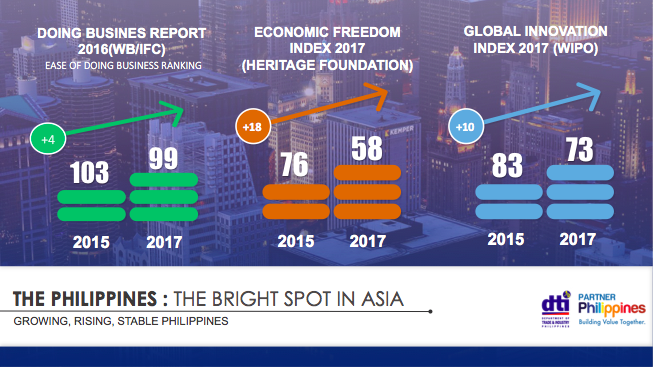
The country’s global competitiveness ranking has continued its marked improvement.
The Philippines climbed four notches in the Doing Business Report from 103rd in 2015 to 99th out of 190 economies in 2016. This was aided by the increased transparency in building regulations. Paying taxes has also been made easier by introducing an online system for filing and paying health contributions, and by allowing for online corporate income tax and VAT returns to be completed offline.
The country has also made it to the top-third of the rankings in the Heritage Foundation’s Economic Freedom Index 2017, up twelve notches to rank 58th out of 180 countries, maintaining its status as a “moderately free” country for four years.
The Philippines also moved up 9 rungs in the Global Innovation Index from 83rd out of 141 economies in 2015 to 74th out of 128 economies in 2016 and up one more to 73rd out of 127 in 2017, as measured by the World Intellectual Property Organization.
The country’s credit rating has continued to improve over the years. As of 2017, the top three rating agencies — Fitch, Moody’s, and Standard & Poor’s — affirmed the country’s “investment grade” rating. The Tokyo-based Japan Credit Rating Agency Ltd. has also affirmed its BBB+ credit rating for the Philippines.

The increasing global competitiveness of the Philippine economy is reflected in the sustained growth in net foreign direct investment (FDI) inflows (FDI) since 2012. The upward trend indicates the growing interest of investors who wish to take advantage of the opportunities presented by the country’s robust economy and stable business environment.
In 2016, FDI reached US$7.9 billion, up by 41 percent over inflows in 2015. Top sectors that gained inflows in 2016 were financial and insurance activities, arts, entertainment and recreation, manufacturing, real estate activities, and construction.
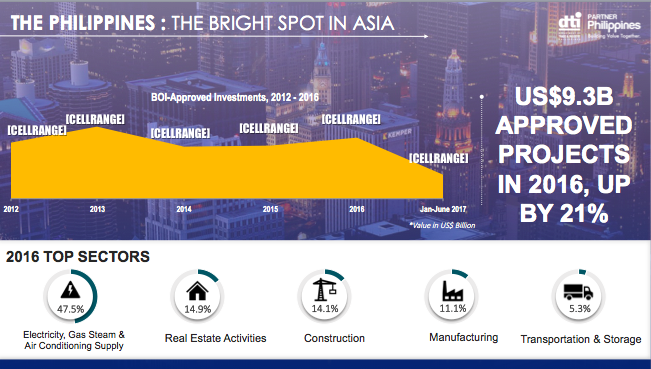
With the sustained improvements in the overall business environment, the Board of Investments (BOI) approved US$9.31 billion worth of projects in 2016, representing a 21 percent increase in investment commitments in 2015.
The top sectors that gained capital commitments in 2016 include Electricity, Gas, Steam & Air Conditioning Supply (47.5%), Real Estate Activities (14.9%), Construction (14.1%), Manufacturing (11.1%), and Transportation and Storage (5.3%). The top sources of foreign capital were Australia (34.1%), Singapore (15.3%), The Netherlands (14.6%), Canada (7.6%), and South Korea (7.2%).
This 2017, some US$3.7 billion worth of projects were approved in the period January-June. The capital commitments were made in Real Estate Activities (42.5%), Construction/PPP Projects (31.7%), Electricity, Gas, Steam & Air Conditioning Supply (13.6%), and Manufacturing (10.1%). The top sources of foreign capital were Singapore (52.2%), USA (11.7%), The Netherlands (10.9%), Denmark (7.9%), and India (5.1%).
Philippine Development Plan (2017-2022): AmBisyon Natin 2040
Under the leadership of President Rodrigo R. Duterte, our country is poised to continue and sustain its remarkable growth and spread prosperity across all sectors with a 10-point Socio-economic Development Agenda:
- Continue and maintain current macroeconomic policies, including fiscal, monetary, and trade policies.
- Institute progressive tax reform and more effective tax collection, indexing taxes to inflation.
- Increase competitiveness and the ease of doing business. This effort will draw upon successful models used to attract business to local cities (e.g., Davao) and pursue the relaxation of the Constitutional restrictions on foreign ownership, except on land ownership, to attract foreign direct investment.
- Accelerate annual infrastructure spending to account for 5 percent of GDP, with Public-Private Partnerships (PPP) playing a key role.
- Promote rural and value chain development toward increasing agricultural and rural enterprise productivity and rural tourism.
- Ensure security of land tenure to encourage investments and address bottlenecks in land management and titling agencies.
- Invest in human capital development, including health and education systems, and match skills and training to meet the demand of businesses and the private sector.
- Promote science, technology, and the creative arts to enhance innovation and creative capacity towards self-sustaining, inclusive development.
- Improve social protection programs, including the government’s Conditional Cash Transfer program, to protect the poor against instability and economic shocks.
- Strengthen implementation of the Responsible Parenthood and Reproductive Health Law to enable especially poor couples to make informed choices on financial and family planning.
In line with the 10-point Socio-economic Agenda, the Philippines’ Department of Trade and Industry with its Board of Investments formulates The Philippines’ Investment Priorities Plan (IPP) that identifies sectors where incentives are offered by the government. The IPP, which has a validity of three years subject to annual review, ensures continuity, consistency, and predictability.
Factors taken into consideration in identifying these priority sectors include job generation in pursuit of inclusive growth as well as opportunities for technology transfer and knowledge/technical skills enrichment. Spatial or geographical requirements as well as industry clustering strategies in attracting investments are also considered.
Under the IPP, there are four priority investment areas: Preferred Activities, Export Activities, Activities with Special Laws, and the Autonomous Region of Muslim Mindanao (ARMM) List.
Under this list, the Top Ten Preferred Activities are:
- Manufacturing
- Agriculture, Fishery, and Forestry
- Strategic Services
- Healthcare Services
- Mass Housing
- Infrastructure and Logistics
- Environment Projects
- Energy
- Innovation Drivers
- Inclusive Business Models
Export Activities cover the manufacture of export products, services exports, and activities in support of exporters.
Activities with Special Laws include areas or activities where inclusion of the IPP and/ or grant of incentives is mandated by law, such as Industrial Tree Plantation (PD 705), Mining (RA 7942), Publication or Printing of Books/Textbooks (RA 8047), Tourism (RA 9593), Refining, Storage, Marketing and Distribution of Petroleum Products (RA 8479), Rehabilitation, Self-Development and Self-Reliance of Persons with Disability (RA 7277), Renewable Energy (RA 9513).
ARMM List include priority investment areas identified by the Regional Board of Investments of the Autonomous Region in Muslim Mindanao. This includes Logistics, BIMP-EAGA (Brunei Darussalam-Indonesia-Malaysia-Philippines East ASEAN Growth Area) related investment enterprises, Tourism, Health and Education Services and Facilities, and Energy.
Opportunities for Investors and Business
Infrastructure Development
In The Philippine Development Plan (PDP) 2017-2022, a key strategy is the development and implementation of infrastructure projects to further the ease of doing business and increase productivity and efficiency by facilitating the smooth flow of people, goods and services.
This offers an abundance of investment opportunities in the development of power and utilities; roads and bridges; water and sanitation; railways, airports and ports; information and communications technology; and security and defense.
Moreover, The Philippines has over 366 economic zones and offers a set of competitive fiscal and non-fiscal incentives to jump start qualified projects from infancy to maturity of business operations.
Fiscal incentives include Income Tax Holiday and Special Tax Rate on Gross Income while non-fiscal incentives include duty-free importation of capital equipment, spare parts and supplies as well as duty-free importation of raw materials and supplies used in export.
While the Income Tax Holiday does not provide exemption from real estate tax, machineries installed and operated in ecozones for manufacturing, processing, or other industrial purposes shall be exempt for the first three years of operation of such machineries. Production equipment not attached to real estate shall be exempt from real property taxes.
A total of 64 big-ticket projects ranging from major road networks, railway systems and bus rapid transit systems to airport and seaport modernization are either for implementation or in the pipeline as part of the Duterte administration’s envisioned “golden age of infrastructure.”
Besides its current projects, the Department of Public Works and Highways (DPWH) is also set to either oversee or implement 10 infra projects in Metro Manila and Mindanao. Among these are: These are the: Bonifacio Global City-Ortigas Center Link Road Project; UP-Miriam-Ateneo Viaduct along C-5/ Katipunan; Metro Manila Priority Bridges Seismic Improvement Project (Guadalupe Bridge and Lambingan Bridge; Widening/Improvement of Gen. Luis St.-Kaybiga-Polo-Novaliches; Cavite-Laguna Expressway; NLEX-SLEX Connector Road; Metro Manila Interchange Construction Project VI; Davao City By-Pass Construction Project (South Section (Road) and Center Section (Tunnel); Panguil Bay Bridge, and Phase 1 of the Metro Manila Flood Management Project.
The Philippines' Strategic Location
The Philippines — strategically located in Asia with a network of international sea lanes and air traffic routes traversing the country — is your ideal gateway to the ASEAN Market. Reachable within 2 to 4 hours by plane and within 24 hours by ship from Asia’s major key cities and travel centers, our country offers one of the fastest, if not the best, access to serve your business interests in the ASEAN market of more than 600 million people, roughly the same size as the European Union today.
The Philippines also provides access to ASEAN’s six free trade agreements with Japan, China, Korea, India, Australia and New Zealand.
Philippines in Demographic Sweet Spot
Apart from our robust economy, strategic location and competitive business environment, the other main attraction for investing in The Philippines is the Filipino people. We have a populatieon of about 100 million with a median age of 23 years. These young people — well educated, highly trainable, hardworking, loyal, and English speaking — comprise our country’s primary asset.
These traits are why there are 10 million Filipinos working outside The Philippines as doctors, nurses, architects, engineers, accountants, teachers, mechanics, seafarers, and all sorts of service staff.
These same traits are also why our Information Technology - Business Process Management (IT-BPM) industry has grown dramatically, from a mere 5,000 workers in 2000 to more than a million to date.
Human Capital Advantage
The competitive advantage afforded by our workforce is highlighted by a recent study conducted by the Japan External Trade Organization (JETRO) where The Philippines was consistently ranked first, ahead of India, Indonesia, Thailand and Vietnam in all categories, including:
- Having Less Linguistic / Communication Problems;
Ease of hiring local staff;
High Quality of Employees, from General Workers to Specialists, Engineers, and Managers;
High Employee Retention Rates
Today, the Philippines is the only Asian country in the top ten of the Global Gender Gap Report of the World Economic Forum. It ranked 7th in the world in 2016 and has consistently been in the top 10 since the first report in 2006.
The report’s Global Gender Gap Index measures the relative disparities between women and men across four key areas: Health, Education, Economy and Politics.
The Philippines has fared well especially in Heatlh and Education, we have been able to ensure that females enter, remain and finish school.
Women’s participation in decision-making and leadership positions has prospered too. More women are getting elected to the Senate and the House of Representatives as well as in Provincial, City and Municipal governments.
As for women’s economic empower, this is supported by appropriate laws and policies which are operationalized in development plans. These include:
RA 7882 “Act Providing Assistance to Women Engaged in Micro and Cottage Business Enterprise”
RA 9501 “Magna Carta for Micro, Small and Medium Enterprises”
RA 10644 “Go Negosyo or Go into Business Act”
Women are key players in the MSME sector. Our data in the Department of Trade and Industry show that 53% of enterprises that registered trade names were own by women, while a study by the Asian Institute of Management (AIM) noted that 63% of managers/owners of businesses they surveyed were women.
Philippines-Canada Trade Relations

At this point, I would like to acknowledge the considerable support that the Canadian International Development Agency has been giving The Philippines in this regard, particularly for the development of cooperatives and micro, small and medium enterprises, the protection of the environment, and the empowerment of women and youth.
We realize, that we will only continue to reap continued economic success with the help of partners. Thus, we are looking to deepen our economic partnership with Canada. Quite frankly, there is a lot of room for improvement in the area of trade and investments.
In 2016, The Philippines was Canada’s 21st trading partner (out of 226), 16th export market (out of 213), and 26th import supplier (out of 207).
Total trade grew continuously over the 5-year period 2011 to 2015 by an average of 6.5 percent with the balance of trade in favor of Canada. However, this slowed down by 8 percent from US$1,027 million in 2015 to to US$945 million in 2016.
Our top export products include: ignition wiring sets (and other wiring sets used in vehicles, aircrafts or ships); electronic conductors (with voltage not exceeding 80v and not fitted with connectors); desiccated coconuts, fresh or dried; syringes, with or without needles; and digital monolithic integrated circuits.
On the other hand, our top import products from Canada are: wood (sawn or chipped, sliced or peeled, of a thickness exceeding 6mm); builders’ joinery and carpentry of wood; wheat and meslin; potassium chloride; and meat of swine, frozen.
Golden Opportunities for Partnerships
In terms of trade, we look to narrowing the gap in our balance of trade by increasing our exports of processed food products (such as fruits, vegetables, marine and ethnic foods), personal care products, furniture, homestyle products, and wearables.
As for investments, the recent pivot of Canada toward Southeast Asia and the ongoing talks to expand economic ties with ASEAN is quite encouraging. We hope that with this Canada will ramp up its investments in The Philippines and make us your primary gateway to ASEAN.
We are particularly interested in securing partnerships in Information Technology – Business Process Outsourcing (IT-BPO) particularly in game development, animation, and Health Information Management System (HIMS).
We also seek more investments and technology transfer in our Manufacturing Sector that has been experiencing a resurgence over the last three years, especially in the areas where you have an acknowledged lead such as aerospace, electronics, food processing, and consumer products.
And, as presented earlier, we are equally keen on forging partnerships for the continuing development of our Infrastructure, which is key to our sustained growth over the long term.
We have high hopes that today will be the start of a new chapter of a deepening economic partnership between our two countries.
Thank you very much and good day.